What BPOS runs · Operate
Every alarm gets a reading.
Every stolen key opens nothing.
How we run servers: one place reads every alarm before a person has to, attackers are given keys that open nothing, and the procedure for both is written down where it can be checked. With the numbers from our own two platforms.
Alert triage is reading an alarm before a person has to: what happened, whether visitors were affected, and what to do. A honeytoken is a key that opens nothing, left where a thief will look, so that using it is the alarm. We run our servers with both, and the procedure for each is written down outside the model.
This article belongs to What BPOS runs. One engine, any output showed the same written procedure producing code or video. This one is about keeping servers up and attackers out, where the same rule holds: the knowledge lives in the procedure, and the model is the smallest part.
One place for every alarm
Since 31 October 2026 every alarm from five platforms arrives in one place. Two of the platforms are ours alone, HikrLink and Hikr. The other three we run with partners, who have agreed to their figures appearing here without their names.
In the 28 days to 28 November it read 917 alarms. 189 reached an inbox and 728 were filed. A model was asked in 189 cases; the other 728 were settled by written procedure alone.
The alarms are of six kinds: a site is down, pages are slow, the server returns errors, the firewall is refusing a lot of requests, a decoy key was used, or something else in the infrastructure raised its hand.
Each one gets the same reading before anyone is told. Who was asking: people, crawlers, or our own checks? Did anyone get through who should not have? What did we change in the minutes before? Does the site answer now? Is this unusual for this platform? From those facts comes a grade, by how many people it touches and how dangerous it is:
- Real incident. A person is told now.
- Needs a look. A person is told, with what to check.
- Handled. Something happened and was dealt with. It goes in the daily digest.
- Noise. It goes in the daily digest and nowhere else.
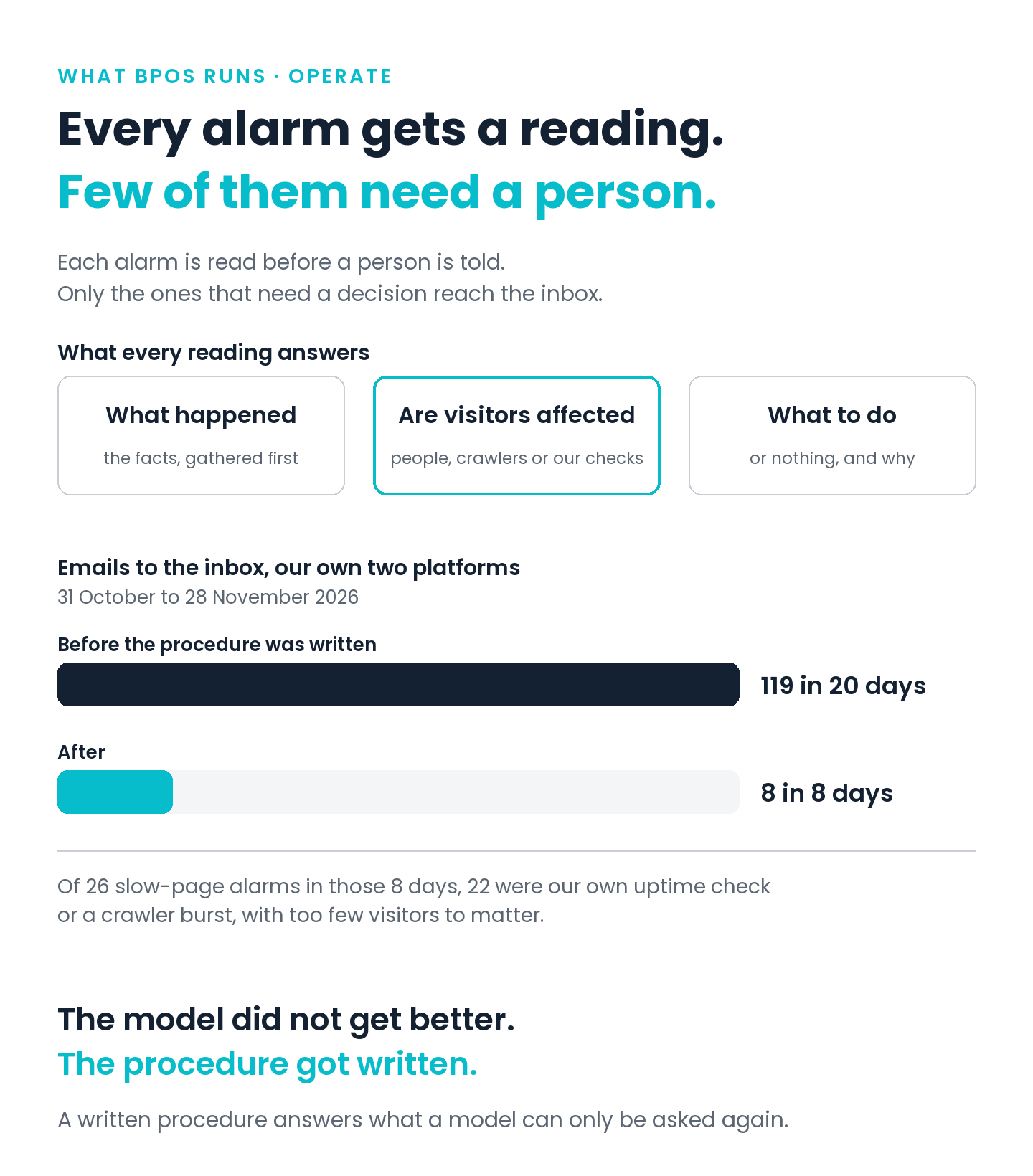
An email that does arrive answers three questions in its first lines: what happened, are visitors affected, what to do.
The alarm that was our own doorbell
These are the figures for the two platforms that are ours alone, from 31 October to 28 November 2026: 174 of the 917 alarms.
In the first 20 days there were 144, and almost all said the same thing: pages are slow on HikrLink. There was no written procedure for a slow-page alarm, so each one went to a model, and each time the model answered that a person should look. 119 emails reached the inbox. That is alert fatigue, built by us, with a model in the loop.
On 20 November we wrote the procedure: separate the slow requests by who made them. In the 8 days that followed there were 26 slow-page alarms. For 22 of them the slow requests were our own uptime check, or in two cases a crawler fetching many files at once, with too few visitors in the window to move the figure. Those were filed as noise: no email, no model. Four reached the inbox.
The same 8 days brought 4 alarms for server errors. Each was matched to a configuration change we had made shortly before, with no visitor affected, and the email said so.
From 119 emails in 20 days to 8 in 8. The model did not get better. The procedure got written, and the model was no longer asked.
What the internet asks our servers for
From 9 to 28 November 2026 the load balancer in front of our own sites recorded 58,501 requests that were either refused or asked for a file that does not exist. They came from 728 addresses in 131 networks.
- 42% asked for a
.envfile (24,518 requests). That is the file where many applications keep their keys. - 20% asked for PHP files (11,639).
- 9% asked for WordPress paths (5,239).
- 7% asked for a
.gitfolder (4,023), where a site's source code and deploy settings can sit.
Nobody was looking for us. The same files are asked of every address on the internet, all day, and the largest single request is for keys. The harvesting of .env files for credentials is documented in a joint advisory from CISA and the FBI.
For an owner the useful question is not why us. It is what were they looking for, and did they get it.
A key that opens nothing
If the largest request is for keys, give them keys. A honeytoken looks like a credential and opens nothing. Nobody has a reason to use it, so the moment it is tried two things are known: a theft happened, and who is trying to use what was taken. The alarm names both.
What an owner gets is time. A real key that leaks is in use before anyone notices it is gone. A decoy that is tried tells you someone is collecting, before a real key is among what they hold.
We run decoys on the platforms we operate with partners. On one of them, from 26 October to 28 November 2026, the decoy system answered 63,922 requests that had no business there and handed out 1,399 decoy keys, to more than 200 addresses in 78 networks.
Twelve of those keys were tried, in 21 attempts. Five attempts came from the address that had taken the key. Sixteen came from a different network than the one that took it, six networks in all: one party collects, another uses. Half of the attempts came within 19 hours of the theft. The longest wait was 15 days.
On a second, larger platform over the same 33 days, 33,019 decoy keys were handed out, to 1,440 addresses in 170 networks. What happened next depended on the kind of key.
- Application keys are tried at once. 356 were tried, every one within 2 to 26 minutes of being taken, half within 14 minutes, and nearly always from the address that took them. One group took 46 keys in three hours and tried all 46, each within 16 minutes.
- Cloud keys are passed on. 31 were tried, in 99 attempts. 95 of those came from a different network than the one that took the key. Half came more than ten hours later, the last after two days.
Three things follow for an owner. There is no grace period for an application key: it is in use within minutes. Blocking the address that took a key does nothing about the address that will use it. And a quiet fortnight after a leak proves nothing: a key can be held for two weeks before it is tried.
The two platforms share no country, no customer and no code. Of the 2,443 groups of attackers followed on the larger one, 551 turned up on the other with the same network and the same technical signature. And most of what those groups sent was not scanning: 69% of their requests were attempts to break in.
Across the three platforms that carry decoys, 67 alarms in 28 days said a decoy key had been used. 62 were graded as handled. Five went to a person.
How the decoys are made stays private, for a plain reason: a published trap is a recognised trap.
One thing we will say against ourselves. Watching is not blocking. A decoy and the record around it protect nothing by themselves. They make the decision about what to block rest on what attackers did, not on guesses.
The procedure is a page, and the model never acts
Today the readings are code, and the system advises: a person acts. The next step is the one BPOS already takes for code and video. The procedure for each kind of attack is written as a skillset page, and a small fixed interpreter runs it. A new response is a new version of a page, reviewed, never new code. The rules we set for those pages on 31 October 2026:
- One shape for every procedure. Gather the facts, say what is happening, check that reading for contradictions, choose among the allowed options, act, measure, then keep what worked or work out whether the reading, the data or the action was at fault.
- Nothing an attacker wrote becomes a fact. Paths, hosts and error text arrive as categories and counts. The words an attacker sends never reach the part that decides.
- The model never acts. It may label a case the rules could not. Its answer can raise the severity or ask for a person. It cannot trigger an action or lower the severity.
- Learning tightens by itself and loosens only by hand. A proposal that adds a detection can be made automatically. Anything that relaxes a defence needs a person's decision on a visible change.
- Every run is evidence. The facts, the branch taken, the action and the outcome are recorded against the version of the page that ran.
The first procedure written this way covers password guessing against a login page. It comes with its test cases: one replayed from a real alarm, four invented, including the one where the person logging in is an administrator and must not be locked out.
Where we stop
- We do not hack back. We refuse access at our own edge and make what is taken worthless. We never touch an attacker's machine, or the machine of the person an attacker is borrowing.
- We publish no addresses. Many of them are ordinary home connections used without their owners knowing.
- The model sees no addresses either. When an alarm goes to a model, the addresses are removed first, and the number of such calls in a day is capped.
- Live routing changes one step at a time. The real domains are confirmed as monitored first. One change is made and watched. The next follows only if nothing broke.
Where it falls short
- Three weeks of noise. 119 emails for one cause before we wrote the procedure that explained it. The cause was in the requests all along.
- It advises. Nothing is blocked or changed by the system today. A person does that.
- Procedures as pages are a draft. One is written and tested on paper. None has run from its page yet.
- No decoys on our own two platforms yet. HikrLink and Hikr have the record of what is asked of them, not the keys that open nothing.
- A short record. Twenty-eight days of alarms, and thirty-three days of decoys on two platforms. Fewer than two decoy keys in a hundred were tried on either, so the figures on use rest on a few hundred attempts on one and 21 on the other.
Common questions
What is alert fatigue?
Alert fatigue is what happens when alarms arrive so often that people stop reading them, and the one that matters is missed among the ones that do not. The cure is not fewer monitors. It is reading each alarm before it reaches a person, so that only the ones needing a decision arrive.
What is alert triage?
Alert triage is reading an alarm before a person has to: what happened, whether visitors were affected, and what to do about it. Ours gathers the same facts for every alarm, grades it as a real incident, something that needs a look, handled, or noise, and sends only the first two to an inbox.
What is a honeypot?
A honeypot is something set up to be attacked that serves nothing real. No customer has a reason to touch it, so whoever does has shown what they are looking for and how they go about it.
What is a honeytoken?
A honeytoken is a fake key or record with no legitimate use, left where a thief will look. It opens nothing. Because nobody has a reason to use it, any use is an alarm, and it tells you a theft happened before a real key is tried.
How fast is a stolen credential used?
It depends on the key. On one platform we run, application keys taken from a decoy were tried within 2 to 26 minutes, half within 14. Cloud keys were handed to another network and tried later, half after more than ten hours. On a smaller platform the longest wait before a decoy key was tried was 15 days.
Does watching attackers protect a website?
Not by itself. Watching shows what attackers ask for and how far they get, so that the rules at the door rest on what they actually did. The protection is still the rules at the door.
Does an AI model decide what gets blocked?
No. Today our system advises and a person acts. In the procedure we have written for the next step, a model may label a case the rules could not, and its answer can raise the severity or ask for a person. It can never trigger an action or lower the severity.
Sources
- Our own records: the alarm record for five platforms, 31 October to 28 November 2026; the decoy records of two platforms run with partners, 26 October to 28 November 2026, with our own test traffic removed; the load balancer's record of refused requests and requests for missing files, 9 to 28 November 2026; the rules for procedure pages, drafted 31 October 2026. All read on 28 November 2026.
- CISA and FBI, Known Indicators of Compromise Associated with Androxgh0st Malware, advisory AA24-016A, 16 January 2024.
Related writing
- One engine, any output. The same written procedure, producing code or video.
- The model is the smallest part. Why the procedure carries the result.
- Served, not installed. Why a procedure is a page that is fetched.
- Where a person decides. The decisions that stay with a person.
- The Siege. Load-testing a platform before its visitors do.
- Infrastructure. The platforms we run, and how.
- What is alert fatigue?. The short answer, with how to measure it.
- What is a honeytoken?. Honeypots, honeytokens and what ours caught.