What BPOS runs · Learn
Served, not installed.
Why our skillsets are web pages.
MCP servers can now publish skills next to their tools. Our skillsets have been pages served over HTTP for the same reasons. This is what the two share, what HTTP adds, and what we have not built yet.
A served skill is a procedure the model fetches from its source at the moment the work asks for it. A BPOS skillset is a set of such pages, served over HTTP, one per stage of a procedure. Nothing is installed, there is one version, and every request is recorded.
This article belongs to What BPOS runs. Beyond SKILL.md covers what a skillset page declares; this one covers why it is served, and how that meets a change in the protocol assistants use to reach tools.
What changed in November 2026
On 24 November 2026 Anthropic announced skills over MCP, in public beta. MCP, the Model Context Protocol, is how an assistant reaches a company's tools. Until now a server offered tools and their descriptions. Now it can publish skills beside them: the guidance for multi-step work, supplied by the server itself.
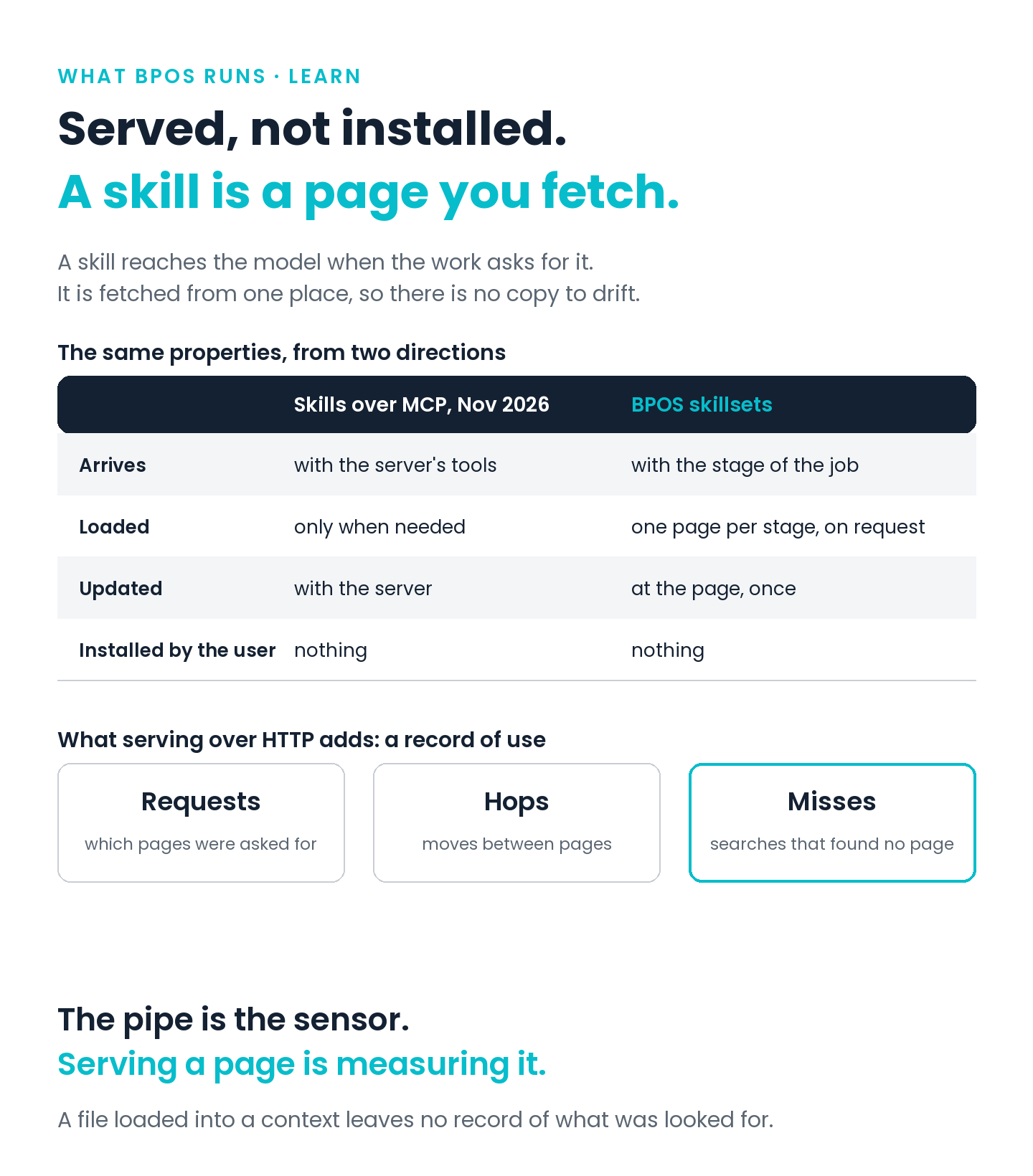
Three properties are stated. The assistant loads a skill only when it is needed. Skills update with the server. The user has nothing separate to install. The reason given is one we recognise: a tool's name and description say what a server can do, not how to handle a particular case.
Why ours were already pages
We wrote the reasons down in August 2026, after learning them the slow way. A document that states a rule has readers only if someone opens it. One of ours sat in a repository for three days while at least four of its points were rediscovered, at cost, by work that never read it. So the format became the mechanism. Four reasons, none of which a file in a folder can meet.
- Loaded at the moment of judgement. A page is pulled by the step that is about to act, not by whoever remembered to read it. That is the difference between a rule an operator has to enforce and a rule the work consults.
- Measurable, because the pipe is the sensor. A document has no telemetry. A page served over HTTP writes a line each time it is delivered: which page, to which step of which job. The delivery joins to the outcome, so "did this page help" is a query, not an opinion.
- Rankable, because pages link. A folder has no graph. Pages that link to each other do, and which rule earns its place becomes something you can compute.
- Usable by a machine, because it is structured. The head of each page is structured data: what the stage emits, what it must read first, what to read instead. The body is the rules, each with an id.
In the 30 days to 10 October 2026 the server recorded 8,486 page requests, 7,809 hops from one page to the next, and 98 searches that found no page at all. The misses are the most useful: each one is a need, in the agent's own words, for a page we have not written.
How the two fit
They meet from two directions. Skills over MCP brings the procedure to the assistant a person talks to. Our pages bring the procedure to the steps inside a job. Both rest on the same decision: the procedure lives with the system that does the work, is fetched when needed, and exists once.
For us the fit is practical. BPOS is reached through an MCP connector. Today the procedures an assistant follows to drive it, how to plan work, how to deploy, are separate skill files: copies, which can drift from the engine they describe. Published by the connector, they would be the same pages the engine already serves, changing when the engine changes.
The same announcement made two other things generally available, and both match a part of BPOS. A server can now pause mid-call to ask a person for input, meant for steps that need sign-off: that is where a person decides, recorded with the call that needed it. And a server can run long work in the background while the assistant carries on, which is what a job is.
What a served page still adds
The announcement does not describe what a server learns about how a skill was used. Ours records it, because each page is a request. And the links between our pages carry weights that move with the outcome of every job, so the procedure is corrected by its own results, as Procedural memory for AI agents sets out. A skill published as written stays as written until someone edits it.
One rule keeps the two records apart: traffic is never evidence that a page is right. Use is not success. Traffic shows what agents need; outcomes show what works.
Where we are short
- Not built. Our connector declares tools only. Publishing skills through it is designed, since September 2026, and not built. The library we use for the protocol has no helper for skills, so that part is ours to write.
- We have not read the protocol detail. The announcement gives the behaviour, not the methods. What follows here about fit is from the behaviour described.
- Our own copies still exist. Until the connector serves them, the assistant-side procedures are files, with the drift that implies.
- Portability. A skill file moves between tools. Our pages run where BPOS runs. Skills over MCP is part of an open specification, which is one more reason to meet it.
Common questions
What is skills over MCP?
A change announced by Anthropic on 24 November 2026, in public beta: an MCP server can publish skills alongside its tools, so the server itself supplies the guidance for multi-step work. The assistant loads a skill only when it is needed, and the skill updates with the server, so the user installs nothing.
Why are BPOS skillsets served over HTTP?
So that a procedure is fetched by the step that is about to act, from one place, with nothing copied. And because a served page leaves a record: which pages were asked for, how a node moved between them, and which searches found no page. A file loaded into a context leaves none.
Does BPOS publish its skillsets as skills over MCP today?
No. Our connector declares tools only. Serving the same pages as skills through the connector is designed and not built, and the library we use has no helper for skills, so that part is ours to write.
What is the difference between a skill file and a served skill?
A skill file is a copy: it sits where it was installed and changes when someone replaces it. A served skill is fetched from its source when the work asks for it, so there is one version, and the source can see that it was asked for.
Sources
- Anthropic, Skills over MCP, Tasks and more, 24 November 2026.
- Our own records: the method note on serving skillsets over HTTP, 11 August 2026; the page-request log for the 30 days to 10 October 2026; the connector's declared capabilities, read on 26 November 2026.
Related writing
- Beyond SKILL.md. What a skillset page declares, and what a skill file cannot record.
- One engine, any output. What the same pages let one engine produce.
- Procedural memory for AI agents. How the links between pages learn from outcomes.
- What a node reads before it acts. The request, from the node's side.
- Independent convergence. Other places where outside work arrived at the same design.
- Where a person decides. The sign-off a server can now ask for mid-call.
- Every alarm gets a reading. The same pages, written for running servers.