Running platforms · Definition
What is a honeytoken?
A key that opens nothing.
A honeytoken is a fake key or record with no legitimate use, left where a thief will look. It opens nothing. Because nobody has a reason to use it, any use is an alarm, and it tells you a theft happened before a real key is tried.
This page belongs to Running platforms. How we run decoys alongside our alarms is in Every alarm gets a reading.
Honeytoken, honeypot, canary token
| Term | What it is | What it tells you |
|---|---|---|
| Honeypot | A system set up to be attacked that serves nothing real. | Who is probing, and what they ask for. |
| Honeytoken | A fake key, file or record planted where a thief will look. | That something was taken, and who is using it. |
| Canary token | Another name for a honeytoken that reports when it is touched. | The same. |
The two work together. The honeypot is where the request lands. The honeytoken is what the visitor leaves with.
What ours caught
From 26 October to 28 November 2026 we ran decoy keys on two platforms we operate with partners, who agreed to these figures being published without their names.
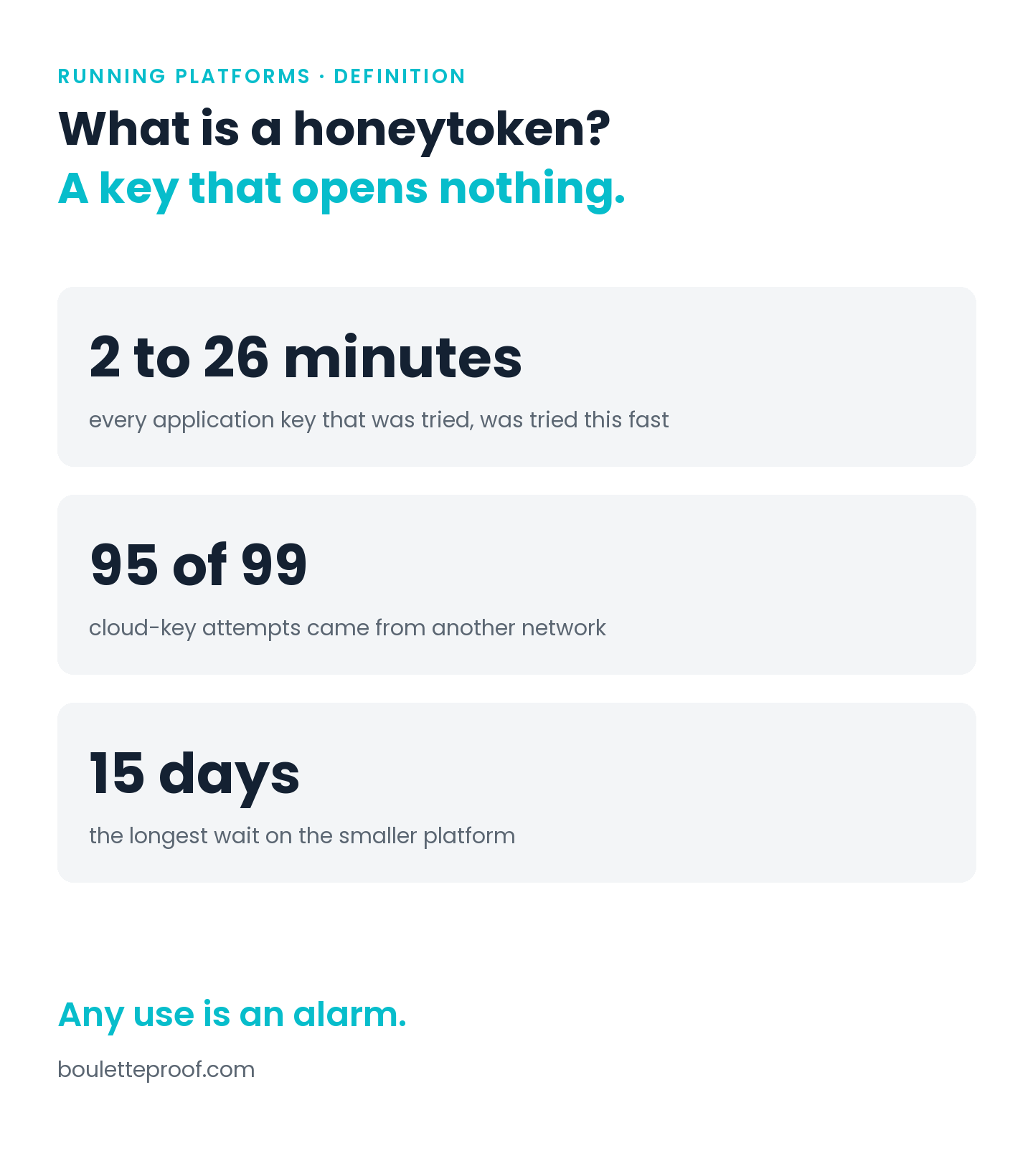
- Application keys are tried at once. On the larger platform 33,019 decoy keys were handed out. 356 application keys were tried, every one within 2 to 26 minutes of being taken, half within 14.
- Cloud keys are passed on. 31 cloud keys were tried in 99 attempts, and 95 of those came from a different network than the one that took the key. Half came more than ten hours later.
- Some are held. On the smaller platform 1,399 keys were handed out and 12 were tried. The longest wait was 15 days.
What that means for an owner
- There is no grace period. An application key that leaks is in use within minutes.
- Blocking the thief's address is not enough. The party that takes a key and the party that uses it are often on different networks.
- A quiet fortnight proves nothing. A key can be held for two weeks before it is tried.
What a honeytoken does not do
It protects nothing by itself. Watching is not blocking. A decoy and the record around it make the decision about what to block rest on what attackers did. The protection is still the rules at the door. And fewer than two decoy keys in a hundred were ever tried on either platform, so the figures on use rest on a few hundred attempts on one and 21 on the other.
How ours are made stays private, for a plain reason: a published trap is a recognised trap.
Common questions
What is a honeytoken?
A honeytoken is a fake key or record with no legitimate use, left where a thief will look. It opens nothing, so any use of it is an alarm.
What is the difference between a honeypot and a honeytoken?
A honeypot is a system set up to be attacked. A honeytoken is a fake item, such as a key, that an attacker takes away. The honeypot shows who is probing; the honeytoken shows who uses what was taken.
How fast is a stolen credential used?
It depends on the key. In our record application keys were tried within 2 to 26 minutes, half within 14. Cloud keys were passed to another network and tried later, half after more than ten hours. On the smaller platform the longest wait was 15 days.
Does a honeytoken protect a website?
Not by itself. It tells you a theft happened and who is using what was taken, so that blocking rests on what attackers did.
Sources
Our own decoy records for two platforms run with partners, 26 October to 28 November 2026, with our own test traffic removed. Read on 28 November 2026.
Want this run for you? See how we run platforms.
Related
- Every alarm gets a reading. Alarms and decoys, read in one place.
- What is alert fatigue?. Why most alarms should never reach a person.
- Load testing checklist. The other half of keeping a platform up.