What BPOS runs · Execute
One engine, any output.
The skillset declares the rest.
Mesh knows nothing about code and nothing about video. It knows how to run a job under control. What the job is comes from a skillset, and what the job leaves behind is kept.
Mesh is the part of BPOS that does the work. It is a set of identical nodes that produce whatever a skillset tells them to produce: a code change, a storyboard, a video clip, a plan. The skillset declares the procedure and the model. Mesh supplies the rest.
This article belongs to What BPOS runs, one mechanism at a time. It follows Nodes, not agents and An agentic mesh in every job, and answers two questions they leave open: what else the same engine can produce, and whether discarding an agent after every job is waste.
Most AI tools are built around one kind of output. A coding tool writes code. A video tool makes video. Each one hides its know-how inside its own software and its own prompts, so the know-how cannot be read, checked or moved. We built Mesh the other way round.
What you get
- One way of working for every kind of output. The same planning, the same checks and the same review, whether the result is a pull request or a thirty-second film.
- Know-how you own and can read. It sits in pages, not in a vendor's model.
- Freedom to change models. When a better or cheaper model appears, you change a declaration. You do not rebuild the system.
A node is empty until it loads a skillset
A Mesh node starts with no role. It is not a coder or a designer. It becomes one at the moment it loads a skillset, and it stops being one when the job ends.
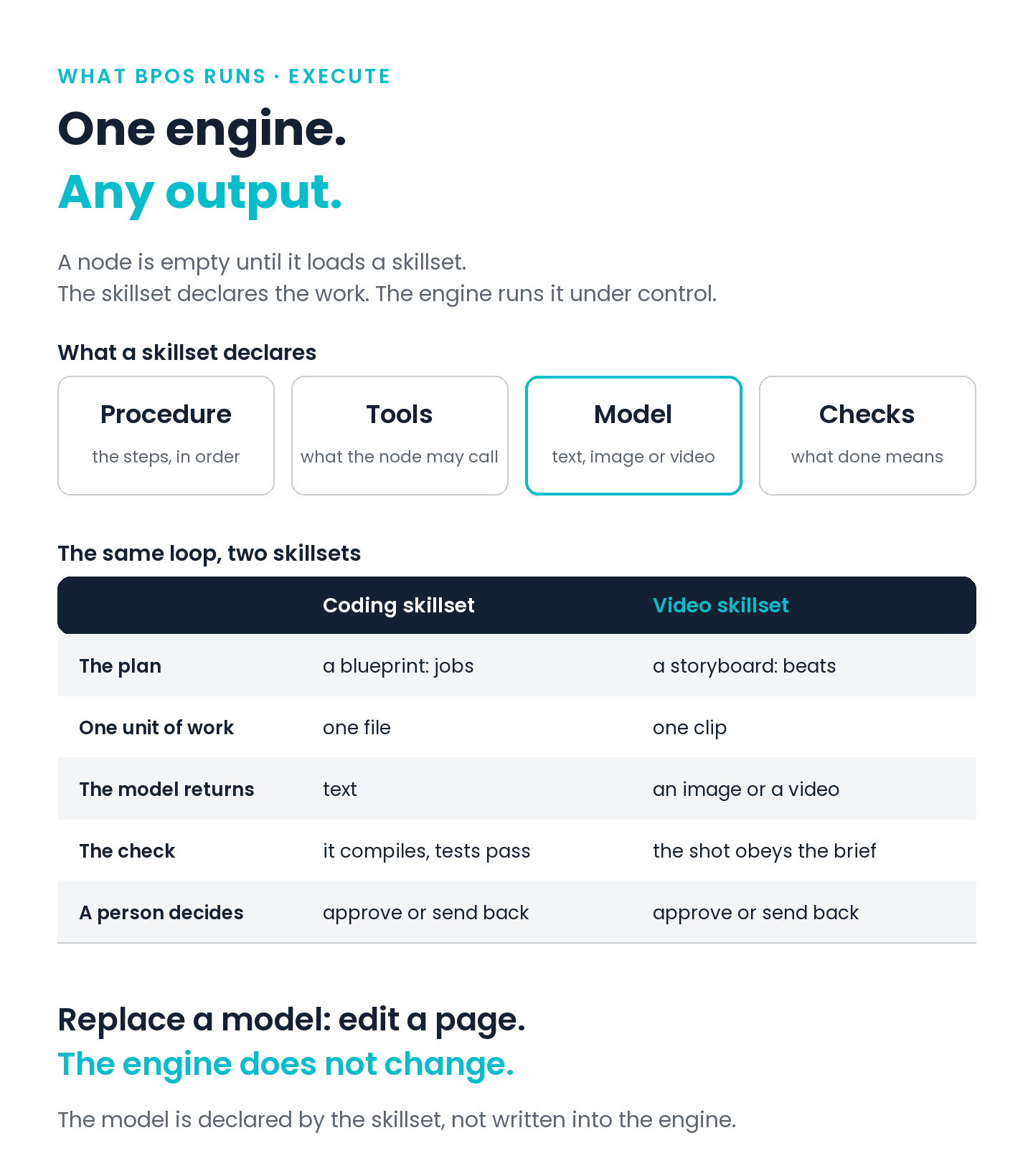
A skillset is not a prompt file. It is a small internal website: HTML pages organised by subject, linked to each other, each carrying structured data a machine can read as well as a person. Beyond SKILL.md describes the pages. For this article, four things a skillset declares matter:
- The procedure. The steps for this kind of work, in order, with the rules that apply at each step.
- The tools. What the node may call while it works: read a file, run a compiler, ask for a measurement.
- The model. Which model this work needs. A text model for code. An image or video model for a shot.
- The checks. What a finished result must satisfy before anyone is asked to look at it.
Node plus skillset equals agent. That is all an agent is in BPOS.
Why the model is declared, not built in
This is the detail that makes "anything" possible. In Mesh, a node makes images or video because the model it was given is declared as returning an image or a video. Not because of the model's name, and not because of a special branch in the engine written for media. The engine reads the declaration and behaves accordingly. A test in the engine holds us to this: a model with a media-sounding name that is declared as text is treated as text.
The consequence is practical. Replacing a video model is an edit to a declaration. It is not an engine release. The same holds for moving between providers: BPOS runs on Anthropic or Google models today, and the choice is a declaration.
We treat a model as a translator: it turns a precise instruction into text, pixels or frames. We do not rely on it for the method. The method is in the skillset, where it can be read and corrected.
Code and video are the same job
Here is the same loop with two different skillsets loaded.
| Coding skillset | Video skillset | |
|---|---|---|
| The plan is | a blueprint: jobs, scope, exit criteria | a storyboard: beats, shots, exit criteria |
| One unit of work is | one file | one clip |
| The node's model returns | text | an image or a video |
| The check is | it compiles, tests pass, criteria met | the shot obeys the written brief: character, style, banned elements |
| A person decides | approve or send back | approve or send back |
One beat, one clip is the same rule as one file, one job. The storyboard is a plan like any other, as A goal has necessary stages describes. Mesh does not need to know the difference, and it does not.
The same reasoning extends to anything that can be described as a procedure with a checkable result: SEO research, data ingestion, a set of ad variants, a decision that needs a statistical model more than a language model. If a skillset can declare the procedure and name the model fit for it, Mesh can run it.
Throwing the agent away is not waste
It looks wasteful: build an agent, use it once, discard it. It is the cheaper design, and nothing of value is discarded.
What is thrown away is a working context, nothing more. An agent that lives for weeks carries a context that grows with every job. You pay for that context on every call, it fills with leftovers from unrelated work, and nobody can audit what it has come to believe. Rebuilding an agent costs one page load: the node fetches the skillset pages it needs, when it needs them. A fresh node starts clean, reads only what this job requires, and cannot inherit yesterday's mistake.
What a permanent agent "knows" is locked inside it. Its experience sits in one vendor's model and one long conversation. Change the model and the experience is gone. In Mesh the experience never sat in the agent, so there is nothing to lose when it ends.
Everything the agent did is kept, as data. Each run leaves a record: which pages the node read and in what order, which steps it walked, what it wrote, what the checks said, how the result was scored, and whether a person approved it. That record goes to two places.
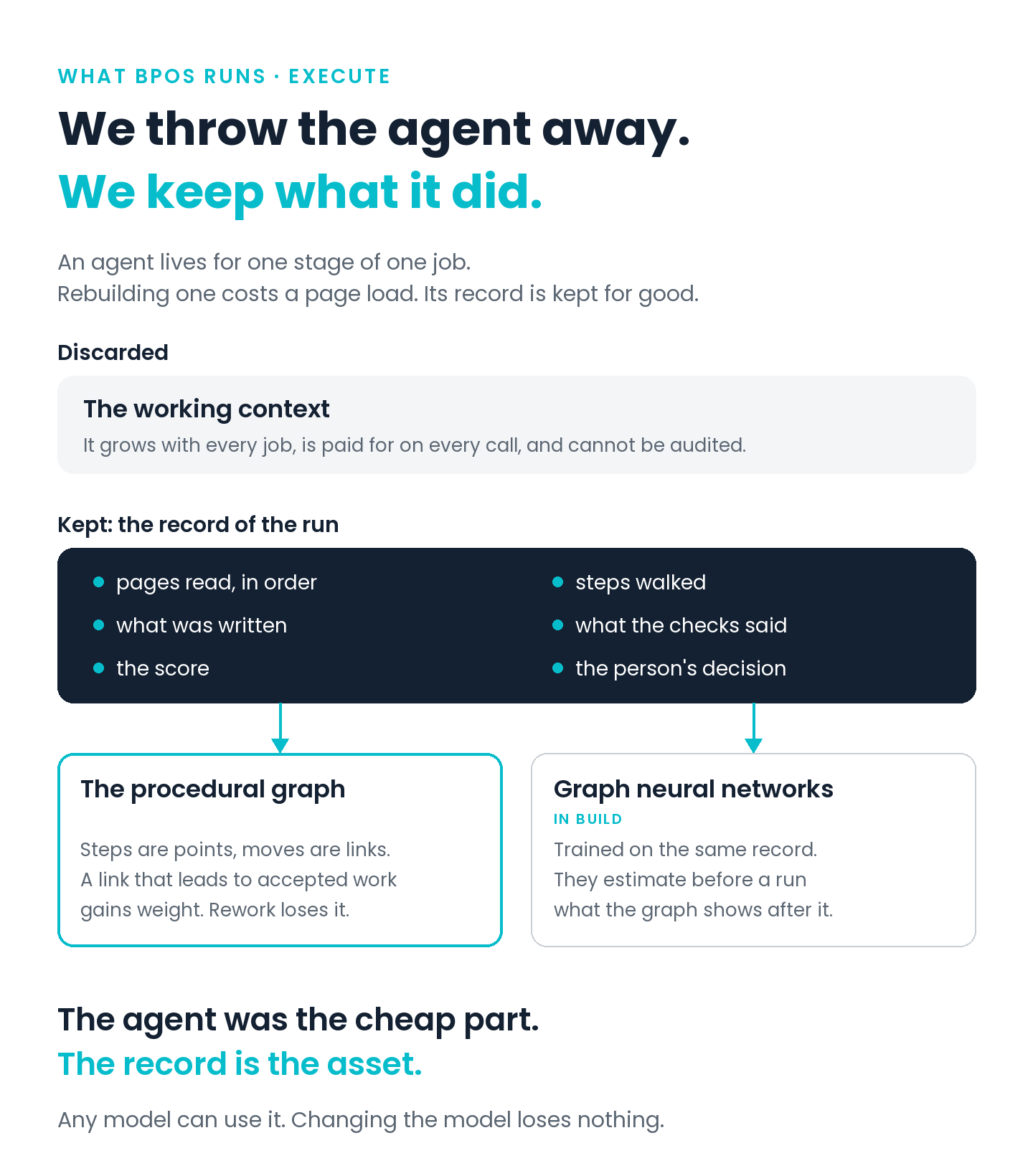
- The procedural graph. The steps of a procedure are points; the moves between them are links. Every finished job is one walk across that graph. A link that leads to accepted work gains weight. A link that leads to rework loses it. Nobody sets a weight by hand: it moves only when a job is observed. The next node that loads the same skillset is served the paths that have earned their place. This is how a recipe written once becomes a procedure that improves with use. Procedural memory for AI agents goes through it.
- Graph neural networks, in build. The same record is the training data for two networks we are building on top of the graph. One reads how nodes move through skillset pages. The other reads what nodes do in Mesh. Their job is to estimate before a run what the graph can only tell after it: how a job should be split, and which path is likely to hold. An estimate enters as one more observation. It never overwrites what real jobs have shown.
So the accounting is the reverse of what it seems. A permanent agent keeps the cheap part, the conversation, and loses the valuable part when the model changes. Mesh drops the cheap part after every job and keeps the valuable part for good, in a form any model can use.
What does not change
Whatever the output, every job passes through the same four parts: plan, execute, judge, learn. Verification happens before generation, not after. Every job ends in one of three outcomes: proceed, warn or refuse. Refusal is a valid result, not an error. And a person decides what ships.
Where it falls short
- No declaration, no work. If the skillset does not declare the procedure or the model, Mesh will not improvise one. It stops.
- Mesh is only as good as its pages. A thin skillset gives thin results. Most of our effort goes into the pages, not the engine.
- Depth differs by domain. Software is where Mesh has run every day and where its skillsets are deepest. The video path, with its storyboard skillset and declared media models, is built on the same engine and is younger.
- The networks are not finished. The procedural graph learns from every job today. The graph neural networks are in build, and we have no figures to publish for them yet.
Common questions
What is Mesh?
Mesh is the execution layer of BPOS, Bouletteproof's constraint engine. It runs jobs across identical nodes that take their procedure, tools, model and checks from a skillset.
How is a skillset different from a prompt or a skill file?
A prompt tells a model what to say once. A skillset is a browsable set of linked pages that declares the procedure, the tools, the model and the checks for a whole kind of work, in a form both people and machines can read.
Can Mesh make video?
Yes, when a video skillset is loaded. The skillset supplies the storyboard procedure and names an image or video model. Mesh treats each clip the way it treats a file in a coding job. Software is where Mesh has run every day; the video path is built on the same engine and is younger.
Is Mesh tied to one AI provider?
No. The model is declared by the skillset, so it can be changed without changing the engine.
Why not keep permanent agents? Is rebuilding them wasteful?
No. Rebuilding an agent costs one page load. Keeping one alive costs a growing context on every call, and its experience is lost when the model changes. Mesh keeps the experience instead: every run is stored as a walk across the procedural graph, where links gain or lose weight from real outcomes, and as training data for the graph neural networks we are building on it.
Sources
- Our own engine, as of 27 November 2026: the rule that a node is a media node because its model is declared as returning an image or a video, and the test that holds it.
Related writing
- BPOS: how we build software with agents. The whole machine, and the series this article belongs to.
- Nodes, not agents. Why an agent lasts one stage of one job, and what is recorded of it.
- An agentic mesh in every job. How the nodes inside a job talk to each other.
- Beyond SKILL.md. What a skill page holds and how it learns.
- Procedural memory for AI agents. The pages and weighted links the record feeds.
- A goal has necessary stages. The plan above the job, and why it can serve as a storyboard.
- Served, not installed. Why the skillset is fetched over HTTP, not installed.
- Every alarm gets a reading. The same written procedure, keeping servers up and attackers out.