What BPOS runs · Learn
Procedural memory for AI agents.
One you can read.
Knowing how to do something is a different kind of memory from knowing a fact. It is learned by practice, and in people it cannot be read. This is how BPOS gives agents that kind of memory, and keeps every step of it on a page.
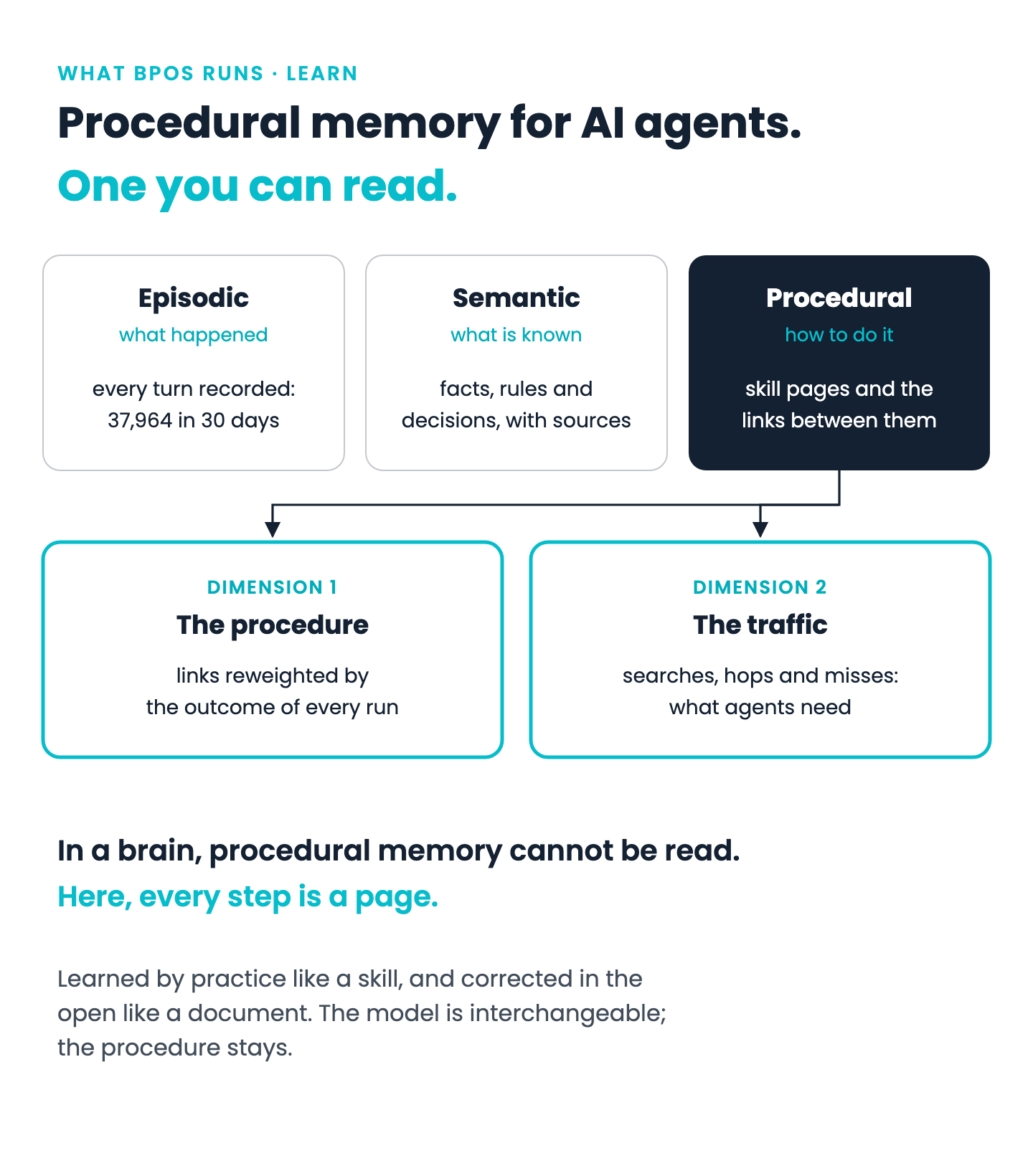
Procedural memory is knowing how: the skills a mind learns by practice rather than by being told. In BPOS, an agent's procedural memory is a graph of skill pages and the links between them. The links learn from the outcome of every run, the pages are served so that every search, hop and miss is recorded, and every step can be read and corrected.
This is the article the rest of the learning series hangs on, from A Hand-Written Map Can Be Worse Than No Map to Nobody Types the Weights. It belongs to What BPOS runs.
What procedural memory is
Cognitive science splits long-term memory by what it holds. Declarative memory is knowing that: semantic memory holds facts, and episodic memory holds the events you lived. Procedural memory is knowing how: riding a bike, typing, a surgeon's suture. It has four properties that matter here.
- It is learned by practice, not by being told. Each repetition adjusts it.
- It improves with outcome. What works is reinforced; what fails fades.
- It is durable and automatic, which is why a bad habit is hard to unlearn.
- It is implicit. You can ride a bike without being able to say how. The knowledge lives in the doing, where nobody can read it.
Where AI agents keep it
The standard map of agent memory comes from Cognitive Architectures for Language Agents (Sumers, Yao, Narasimhan and Griffiths, Princeton). It gives an agent a working memory and three long-term ones: episodic, semantic and procedural. Procedural memory, it says, lives in two places: implicitly in the model's weights, and explicitly in the agent's code. A SKILL.md is the second kind, a written recipe; a recent benchmark, AFTER, treats each SKILL.md as one unit of procedural memory.
Neither place learns by practice on its own. Weights change only by retraining, and code or prompts change only when someone rewrites them. Research is moving on this: Memp builds procedural memory from past runs and keeps updating it, and finds that memory built with a stronger model still helps when moved to a weaker one. The same paper that drew the map also gives a warning: an agent writing to its own procedural memory is riskier than writing to the other kinds, because it can introduce bugs or work against what its designers intended.
A third place: pages and links
BPOS keeps procedural memory outside both. A skillset is a set of pages, one per stage of a procedure, and the links between them say what a stage must read and when a transition applies. A recipe written once becomes a procedure that keeps learning. Beyond SKILL.md covers what each page declares; this article covers how the whole of it learns. It learns in two dimensions.
Dimension one: the procedure learns from outcomes
When a job's outcome is known, every link its steps walked is reweighted by it: stronger where the work ended well, weaker where it did not. Links nobody walks fade slowly, and a faded link is still tried now and then, so it can return if it proves useful. That is practice and reinforcement, the first two properties of procedural memory. The rule comes from a slime mould and is set out in Nobody Types the Weights.
Two choices keep it honest. Use is not evidence: we once weighted links by how often they were walked, and a path to a dead end grew stronger the more agents went down it. And nobody sets a weight by hand; a reviewer's refusal enters as an observation through the same rule as any outcome. The research that tested hand-written procedure found it could make an agent worse than none at all, until the procedure could change with use; A Hand-Written Map Can Be Worse Than No Map covers it.
Dimension two: the traffic shows what agents need
Because the pages are served over HTTP, the server records how agents use them, for free. In the 30 days to 10 October 2026: 8,486 page requests, 7,809 hops from one page to the next, and 98 searches that found no page at all, each keeping the need in the agent's own words. The misses are read back as demand that was not supplied.
Traffic never changes a link's weight; that would bring back the dead-end problem. It answers different questions: which pages agents look for, how they move, where they loop, and which pages should exist and do not. Procedure says how to act; traffic says where the procedure is thin.
The episodes it learns from
Procedural memory learns from episodic memory. In BPOS the episodes are complete: every turn of every agent is recorded, 37,964 of them in the same 30 days, with the reply, the tool calls and the outcome. After each job, a separate run asks why it ended where it did, successes included, and when the answer points at a page, it proposes a correction to that page. It proposes; it does not rewrite. Semantic memory, the facts, rules and decisions in our knowledge graph, sits beside both and is kept apart from them.
Why readable matters
The fourth property of human procedural memory, that it cannot be read, is the one we did not want. It is also the source of the risk the research warns about. When procedure lives in weights, a bad change is invisible. When it lives in code an agent rewrites, a bad change is a bug. When it lives on a page, a change is visible, dated, sourced and reversible, and a person and the next agent read the same thing.
It is also why the model is interchangeable. The procedure does not live in it, so changing the model does not erase what was learned. Memp found the research version of the same thing: procedural memory outlives the model it was built with.
Where we are short
- Corrections are proposed faster than they are proven. The part that measures whether a page correction actually helped, before it is kept, is still the open part of the loop.
- Most procedure is still thin. Only the coding skillset holds a procedure that runs a whole unit of work, and the misses are a backlog of pages not yet written.
- A company's procedural memory is next. Lite, our knowledge layer, holds a company's rules explicitly, but rules do not yet learn from outcomes the way our links do. A context graph in production says where that stands.
Common questions
What is procedural memory?
Knowing how, as opposed to knowing that. It holds skills such as riding a bike or typing: learned by practice, reinforced by what works, durable, and largely implicit, so you can do the thing without being able to say exactly how.
What is procedural memory in an AI agent?
The knowledge of how to do a task. Most agents hold it implicitly in the model's weights or explicitly in their code and prompts, such as a SKILL.md. BPOS holds it in skill pages and the links between them, which learn from the outcome of every run and can be read and corrected.
How is procedural memory different from semantic and episodic memory?
Semantic memory holds what is known, such as facts and rules. Episodic memory holds what happened, such as each turn of each agent. Procedural memory holds how to act. In BPOS the three are kept apart, and the episodes are what the procedure learns from.
Sources
- Theodore R. Sumers, Shunyu Yao, Karthik Narasimhan, Thomas L. Griffiths, Cognitive Architectures for Language Agents, Transactions on Machine Learning Research, 2024, arXiv:2309.02427.
- Runnan Fang et al., Memp: Exploring Agent Procedural Memory, arXiv:2508.06433.
- Julia Belikova, Rauf Parchiev, Evgeny Egorov, Managing Procedural Memory in LLM Agents: Control, Adaptation, and Evaluation, arXiv:2606.23127.
- Our own records: turns, page requests, hops and misses over the 30 days to 10 October 2026.
Related writing
- Beyond SKILL.md. What each page of the procedure declares.
- Nodes, not agents. Why we keep what agents did, and not the agents.
- The Gettier problem for AI agents. How the episodes become lessons: asking why a job worked.
- The Pigeon Was Not Superstitious. The Reader Was. What a learning signal can and cannot tell you.
- A Green Build Is Not Knowledge. Why passing is not the same as learning.
- A context graph in production. The same idea, for a company's knowledge.