Lite · In beta, by invitation
A context graph, in production.
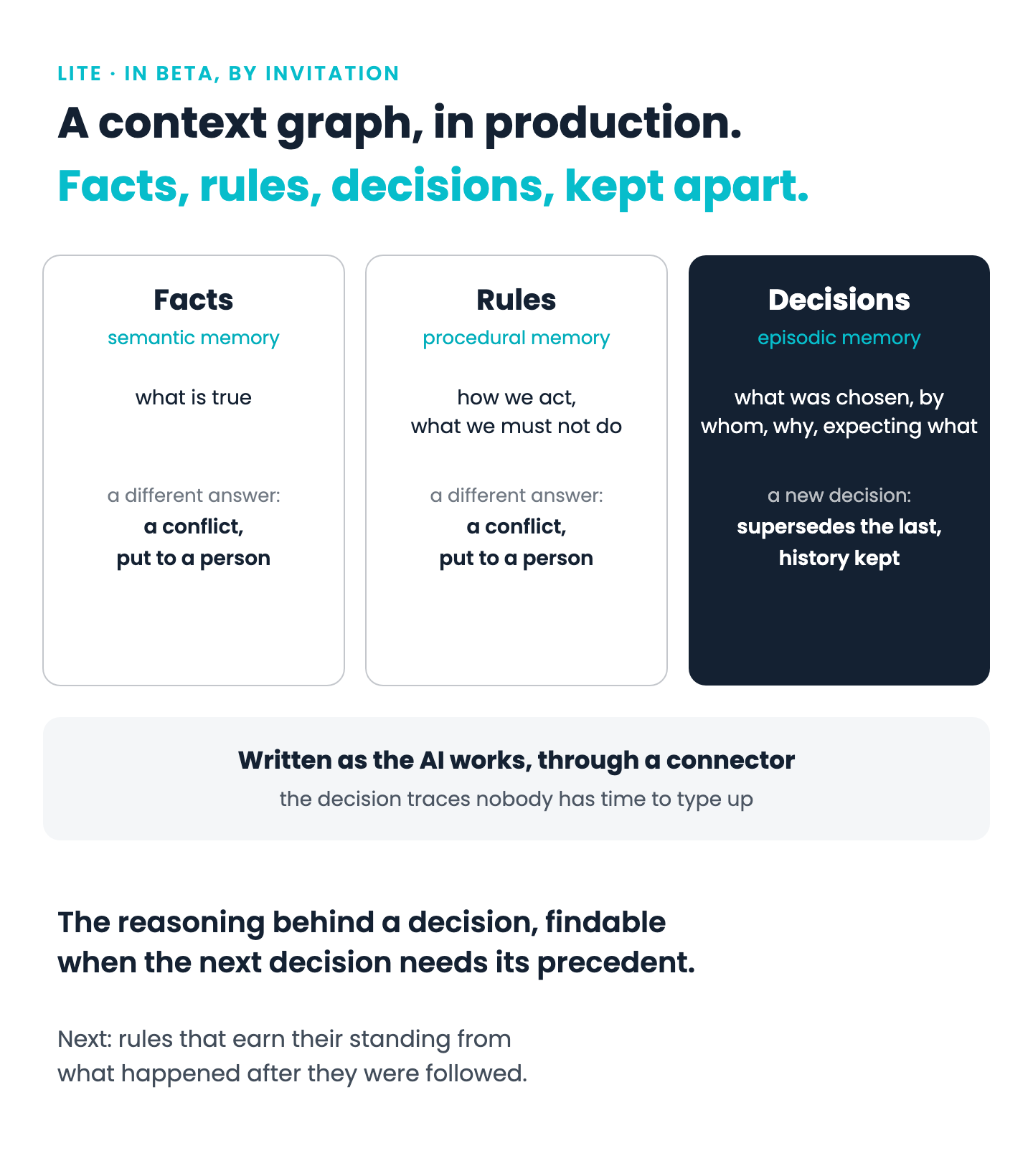
Facts, rules and decisions, kept apart.
Investors call it the missing layer for AI: a record of why a company decided what it decided. We have been running one. This is what it keeps, how it answers the hard objections to the idea, and what it does not do yet.
A context graph is a record of a company's decisions and the reasoning behind them, connected across people, systems and time, so that the next decision can find its precedent. Lite, a knowledge layer built on BPOS's knowledge graph and knowledge base (Lite is its working name), is ours. It keeps facts, rules and decisions apart, and it is written as the AI works.
This article closes What BPOS runs: the machinery we built for ourselves, offered as a product.
What is a context graph?
Ashu Garg and Jaya Gupta of Foundation Capital have made the case for context graphs; in January 2026 Garg talked it through in Why context graphs are the missing layer for AI. Their argument: as agents move into production, models are good enough for most work, and what agents lack is context. Agents can read data and act, but nothing records the reasoning behind a decision: why a customer got an exception, why an incident was escalated, why one fix came before another. They call that reasoning a decision trace. It lives in chat, email and tickets, or nowhere, and it almost never reaches a system of record. Whoever captures decision traces and connects them into a context graph, they argue, will own the most valuable layer in enterprise AI.
We agree with the diagnosis, and we have something to add from running one: a company's memory is not one kind of thing.
Three kinds of claim, three kinds of memory
Cognitive science splits memory into what you know, what happened to you and how you do things. A company's memory splits the same way, and most tools store all three as one.
- Facts are semantic memory: what is true. A fact changes when a new observation says otherwise, and for no other reason.
- Decisions are episodic memory: what was chosen, by whom, on what date, why, expecting what, and replacing what. A decision is never "wrong" the way a fact can be; it is replaced by another decision.
- Rules are procedural memory: how the company acts and what it must not do. In most companies this is the tacit part, the institutional knowledge that sits in people's heads and leaves with them.
Lite stores every claim with its kind, its source, its author and its date, and each kind behaves differently. That behaviour is declared as data in Lite, not written into its code. A Decision Is Not a Fact explains why mixing them goes wrong.
How it answers the hard objections
The context-graph thesis comes with its own bear case, discussed in the same conversation. Three objections stand out. Here is how Lite meets each.
People disagree. Semantic layers failed partly because two people define the same number differently, and the disagreement is human, not technical. Lite does not settle it for them. When a new fact or rule answers a question differently from one already held, both are put in conflict, and the reply says which claims disagree and what a person has to decide. Nothing is silently overwritten.
Truth changes. An agreement is out of date the moment the business moves. Lite does not delete; a new decision supersedes the last, and the old one stays readable with who replaced it, when and why. Every decision has to state its rationale and the outcome it expects, which is what makes it a decision trace rather than a note.
Nobody types it up. People will not train agents by hand any more than salespeople fill in a CRM. Lite is written by the AI as a side effect of the work, through a connector to the assistant the company already uses: it ingests what the work establishes, answers what the work asks, and records decisions as they are made. The call log keeps fingerprints of what was sent, not the values.
Built by BPOS
Lite is a product of its own, built from a part of BPOS: its claim layer, taken out and offered to companies. BPOS built it, through the six-stage program described in A goal has necessary stages, and it runs on the same idea that runs BPOS: the intelligence lives in a record the work can read and correct, not in the model. Beyond SKILL.md shows that idea applied to procedure; Lite applies it to a company's knowledge.
What it does not do yet
- Rules do not yet learn from outcomes. Lite holds a company's rules explicitly, and every decision states the outcome it expects. Closing the loop, so that a rule earns or loses standing from what happened after it was followed, is the part we are building now. It is what turns a record of rules into procedural memory that learns.
- No forecasting yet. BPOS measures the shape of plans and their outcomes; whether that measurement can predict, before the work runs, is still being tested. None of it is in Lite yet.
- It is a beta. A handful of people use it, by invitation.
Lite is in beta, by invitation. What it offers is on the Knowledge Layer page, with a way to get in touch.
Common questions
What is a context graph?
A record of a company's decisions and the reasoning behind them, connected across people, systems and time, so that the next decision can find its precedent. Foundation Capital, the venture firm, made the term widely known.
What is a decision trace?
The reasoning behind a decision: why an exception was granted, why an incident was escalated, why one fix came before another. It usually lives in chat, email and tickets, or nowhere, and almost never reaches a system of record.
How is Lite different from a knowledge base?
A knowledge base holds documents for people to read. Lite holds claims, each with its kind, its source, its author and its date, and answers the questions the work asks. Facts and rules that disagree are put to a person; a new decision supersedes the last and keeps its history.
Sources
- Ashu Garg, with Jaya Gupta, Jamin Ball and Animesh Koratana, Why context graphs are the missing layer for AI, Foundation Capital, 16 January 2026.
- Lite's own definitions of claim kinds and links, as deployed in October 2026.
Related writing
- Knowledge Layer. What Lite offers.
- A Decision Is Not a Fact. Why the three kinds must stay apart.
- Nobody Reads It. The Work Asks It. Why the record answers the work instead of waiting to be read.
- BPOS: AI agent orchestration, from a goal to shipped work. The machine Lite comes from.