Architecture & Method
A hand-written map
can be worse than no map.
Given no guidance, an AI agent scored 87.50 on a benchmark task. Given an expert’s map of the task, it scored 58.93. A new paper shows what repaired it, and where our own system still falls short.
A procedural graph holds a task’s know-how outside a model, as steps and the moves allowed between them. It can be read and corrected without retraining anything.
If you have written down how your agents should work, in runbooks, pages or prompts, this paper asks a plain question. Is that knowledge helping them, or getting in their way?
The paper is by researchers at Google, Georgia Tech and Peking University, published in September as arXiv:2609.09153. We build the same kind of object, so its answer applies to us too.
What repaired the score
Following the expert map was worse than having none. One offline revision of the map made it worse again, at 53.57.
The score recovered only when the map could change during use. Each change was kept only if a held-out test did not fall. That reached 92.86.
A map built from nothing, under the same loop, reached 91.07. On a second benchmark, the map built from nothing was the best result of all.
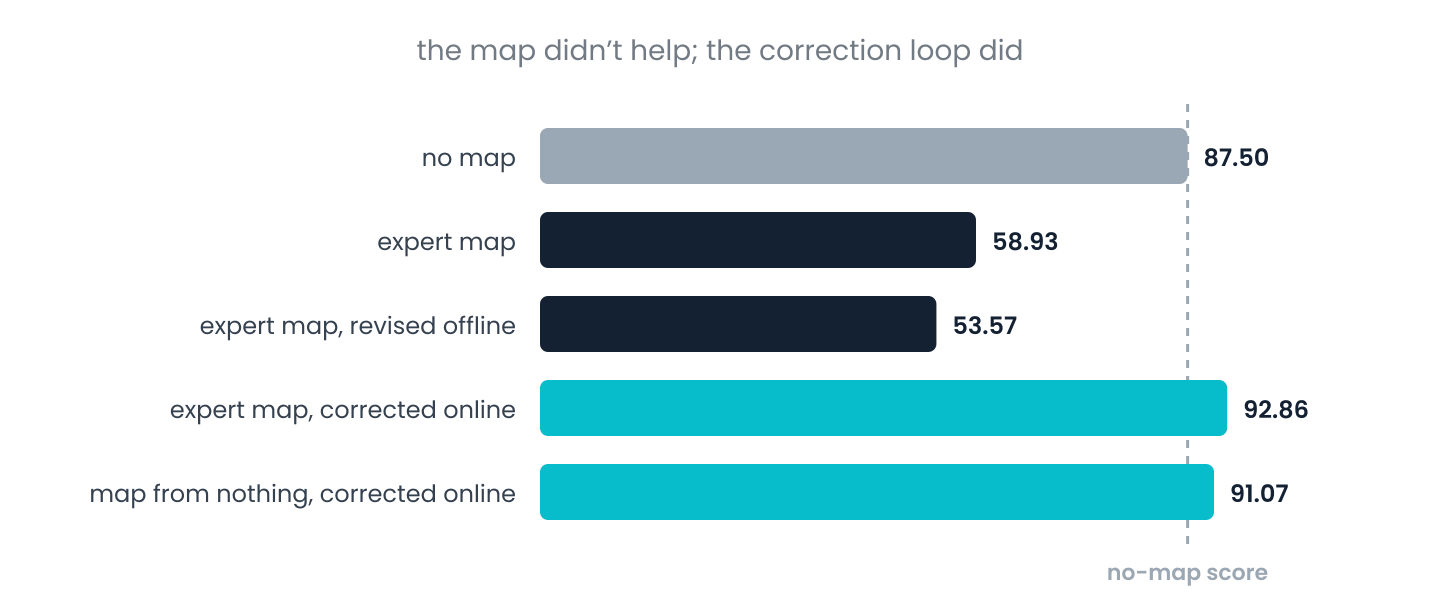
Only the two maps that were corrected during use beat having no map at all. Figures are the authors’.
The value was never in the map. It was in the loop that corrects it. A map without that loop is a liability that sounds authoritative.
Where that leaves us
Our knowledge pages are hand-written. The part of our system that proposes corrections to them runs at volume.
As of 22 September, it had rejected 1,072 proposals, held 291 for observation, and promoted 22, all on a single day.
The part that measures whether a correction helped has not kept up. Measured outcomes exist for six proposals.
In the paper’s terms, our correction loop is open. Until it closes, our hand-written pages are a hypothesis, not an asset.
Each has the half the other lacks
The paper’s changes arrive in batches. A reviser compares failed runs with successful ones and proposes edits.
A batch is kept only if a held-out score does not fall. Rejected batches are remembered, so a bad idea is not proposed twice.
Our changes are continuous. Every link carries a weight that moves with the results of the work that used it. Nobody sets that weight by hand.
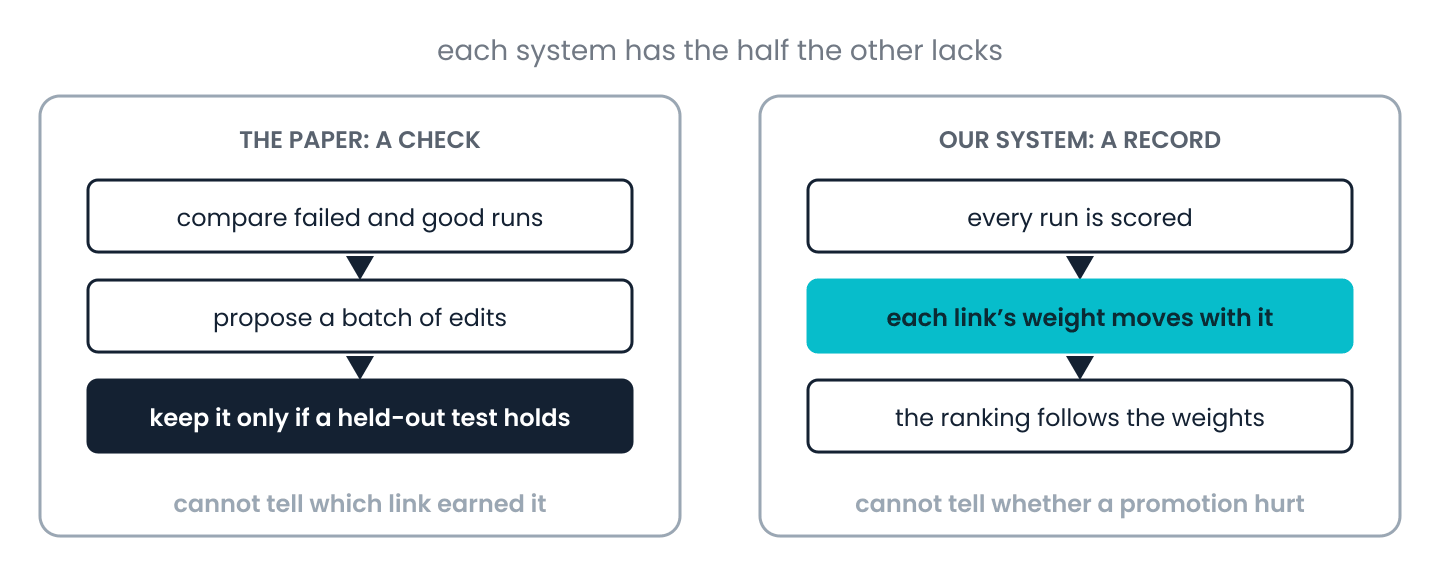
Their check guards every change but keeps no history per link. Our record keeps the history but guards nothing.
They cannot tell which link earned an improvement. We cannot tell whether a promotion made things worse. We are adding their check to our system.
Three findings worth taking
Less of the map beats more of it. Giving the agent the whole map dropped one benchmark score from 72.58 to 54.48, at 96,360 tokens per task. Showing only the two steps around its position scored 81.53, at 28,064 tokens.
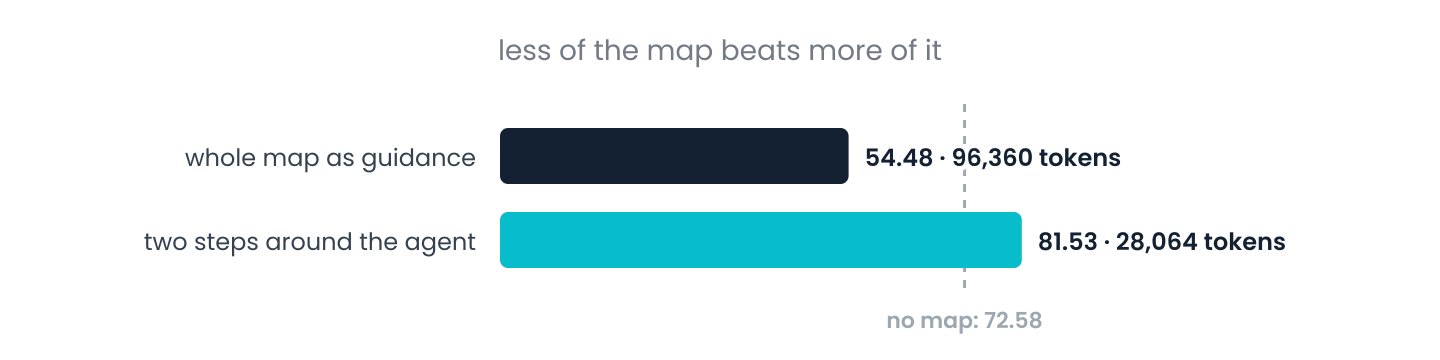
70.9% fewer tokens and 27 points better. Figures are the authors’.
Faster is not cheaper. Local guidance cut the agent’s steps from 28.20 to 18.57. Total token use still rose 33.4%.
Report what you keep, not the best you saw. Their final map scores 85.0 on test. One search round scored 95.0, and they do not headline it. Quoting it would mean choosing on the test set.
They also warn that with twenty test runs per split, single keep or reject decisions turn on one or two runs. We now say the same about our own replays.
What we are taking, and what we are not
Taking: their check on structural change. A promotion lands only if a held-out measure holds.
Taking: their rejection memory. A refused proposal becomes evidence, not a repeat.
Not taking: revising a link by deleting it and adding it back. That throws away everything the link has built up. A reworded description is not a new link.
The history on a link is the one part of the record we cannot rebuild.
Common questions
What is a procedural graph?
A structure that holds a task’s know-how outside a model, as steps and the moves allowed between them. It can be read and corrected without retraining.
Why would guidance make an agent worse?
Because guidance gets followed. A wrong or over-specific instruction overrides the agent’s own judgement and routes it somewhere it would not have gone alone.
Is expert knowledge worthless, then?
No. It is an untested hypothesis until a loop measures it against no guidance. In the paper, the expert map recovers once that loop exists, and on the first benchmark it wins.
Where is the paper?
Yuxing Lu, Yicheng Chen, Shanchan Wu and Sercan Ö. Arık, Procedural Graphs: Self-Evolving Execution Structures for LLM Agents, arXiv:2609.09153v1, 8 September 2026.
Related writing
- The Model Is the Smallest Part. Why the system around the model carries the quality.
- A Green Build Is Not Knowledge. Why passing is not the same as verified.
- Limitations, Perceived and Real. Seven of eight reported limits were never there.