Architecture & Method
The pigeon was not superstitious.
The reader was.
A soap film, a slime mould and a pigeon each add one thing to a rule that learns. We wrote the fourth thing into BPOS. Then we measured our own graph, and found we had been reading it the way Skinner read his birds.
A learning rule changes what a system prefers from what happened to it, without anyone setting the preference by hand. Three older systems show what such a rule needs, one part at a time. The fourth part is ours, and the law is written out below.
The soap film: structure from local forces
Dip two glass plates with pegs between them into soapy water. The film pulls itself into a network joining the pegs, often close to the shortest one.
No part of the film knows the whole network. Each patch only pulls on its neighbours, and the shape emerges from those local forces alone.
It also forgets everything. Lift it out and dip it again, and the network is rebuilt from nothing. It settles into a low-energy shape, with no guarantee of the lowest, which is why people shake the plates.
Scott Aaronson examined the folklore that soap films solve this hard problem, and made the point that matters here. A film reaches a local minimum. Nothing forces it to find the global one.
What it adds: global structure from rules that only see their neighbours. What it lacks: memory.
The slime mould: the same, with memory
The slime mould Physarum polycephalum spreads as a web of tubes that carry nutrients. A tube that carries more flow thickens. A tube that carries little is reabsorbed.
Put it in a maze with food at two exits and the web shrinks to the shortest path between them. Given food placed like the cities around Tokyo, it grew a network comparable to the rail system.
Tero, Kobayashi and Nakagaki wrote the law down in 2007. Each tube’s conductivity grows with the flow through it and decays on its own.
Unlike the soap film, the web remembers. Yesterday’s good route is cheaper today, and the network persists between problems.
The guarantee has conditions. The dynamics provably reach the shortest path only for some settings of the law, and adding saturation breaks the proof. Keep that in mind: saturation broke ours too.
What it adds: reinforcement that persists. What it lacks: any way to tell a useful tube from a merely busy one.
The pigeon: reinforcement on a timer
In 1948 B. F. Skinner fed hungry pigeons on a fixed timer, whatever they were doing. Each bird developed its own ritual: turning, head-bobbing, pecking at nothing.
Skinner called it superstition. Whatever a bird was doing when food arrived got strengthened. So it did it more, and was doing it again next time.
In 1971 John Staddon and Virginia Simmelhag repeated the experiment and recorded it second by second. Near feeding time, every bird did the same thing: it faced the hopper and pecked.
Between feedings, the birds showed the ordinary behaviour of a hungry pigeon waiting for food. The behaviour was organised by the timing of the food, not stamped in by coincidence.
Later work did not simply reverse Skinner. Coincidental reinforcement still appears under some conditions. But coincidence alone does not explain what the birds did, and the ritual Skinner saw was largely his reading of it.
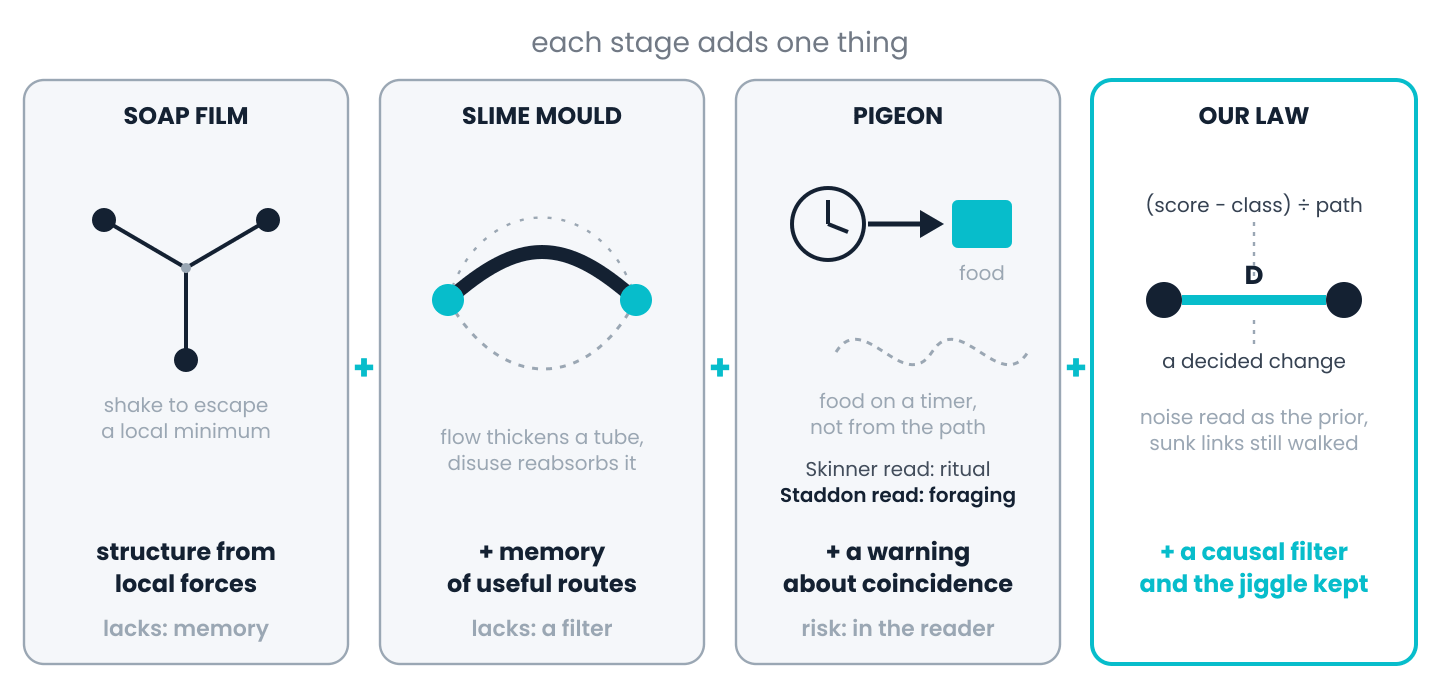
Each stage keeps what came before and adds one thing. The pigeon’s contribution is a warning, and it points at two places: the rule, and whoever reads the rule’s record.
What it adds: a warning with two halves. A rule that credits whatever was present when the reward came will learn nonsense. And someone reading the record can invent a pattern the learner never had.
The fourth term: our law
BPOS keeps its know-how outside the model, as pages linked into a graph. Work walks those links. Each link carries a conductivity, D, updated after every job that walks it:
Dt+1(e) = (1 − λ)·Dt(e) + λ·(D0 + f0 + f1)
Each link starts at a prior, D0. Each update keeps most of the old value and moves the rest toward the prior plus what the work fed it. The rate λ is fixed and small.
The food comes in two kinds. f0 is an outcome: the job’s score minus the usual score for its class of work, divided over the links it walked. f1 is a decision taken on purpose, such as a retry with a known change.
Solve for where it settles and you get one line: D* = D0 + E[f0 + f1]. A link’s conductivity is the prior plus the average of what the work actually fed it. Nothing else.
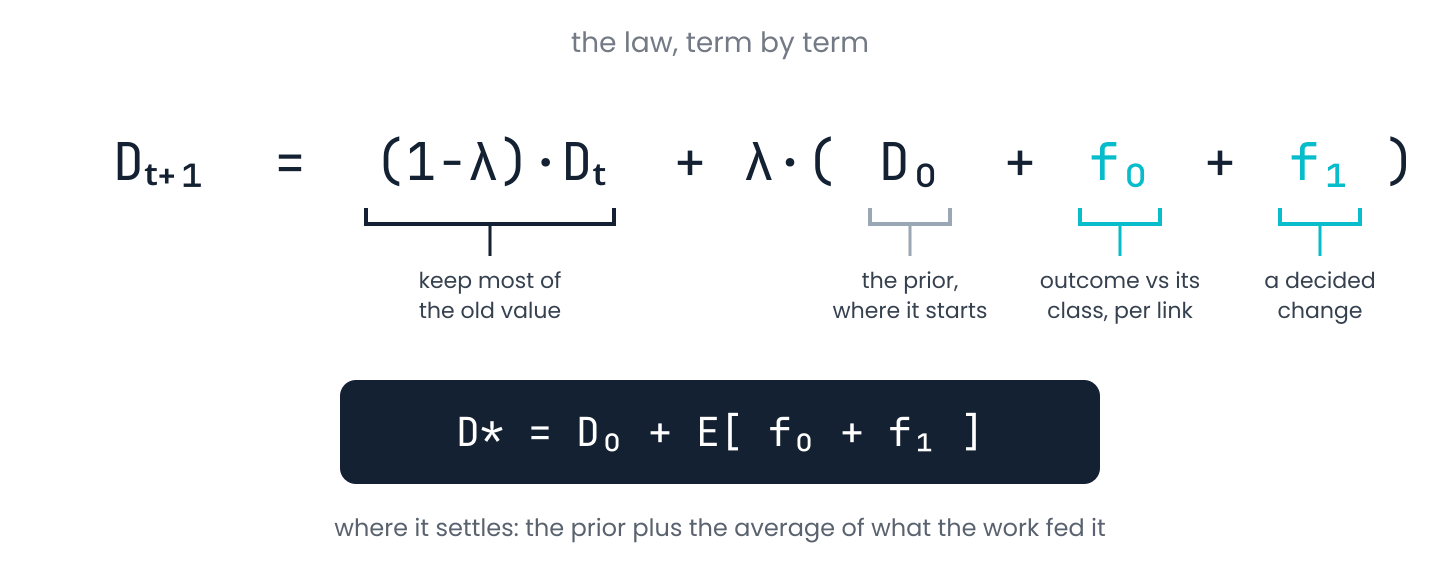
The prior is where a link starts. The two kinds of food are the only way it moves.
Presence earns nothing. f0 subtracts the class baseline, so a link merely present on every walk averages zero food and stays at the prior. That is the pigeon’s failure, removed by construction.
Short routes beat detours. Dividing by path length means a short walk that beat its class feeds each link more than a long detour does. That is the slime mould’s economy.
Noise is read as noise. When a link’s food keeps changing sign, the rule treats it as the prior, however high its value sits today.
The plates still get shaken. A link that has sunk below the walking threshold is still walked now and then, so evidence can always bring it back. We kept the jiggle on purpose, after finding that without it a sunk link could never recover.
Each of these properties is a test that runs on every build. The law is not described once and trusted. It is checked.
Then we read our own graph
A law like this invites the very reading it was built to prevent. So on 23 September we checked what our graph had actually earned.
Under the current law, 444 links carry a recorded history of food. Thirteen have earned a positive average. The largest was earned from a single job.
The links that rank highest today did not get there by earning. Every one holds a starting value, or residue of the rule we retired. The law has not yet seen enough to wash it out.
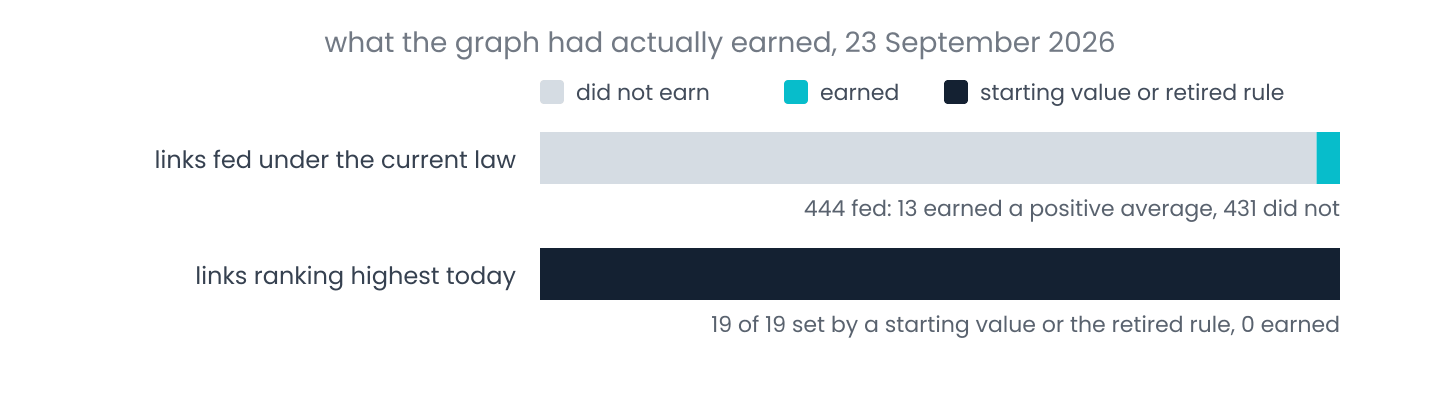
The graph is young. What looks like earned structure at the top is mostly where links started.
Most links fed once sit within a thousandth of the prior. That spread is the starting point, not learning. Reading “this route pays” off it would be reading the prior plus noise.
We would be doing exactly what Skinner did: reading structure off a record whose structure is mostly its baseline. Staddon’s correction lands on us, one system down.
The law is right. The graph is young. The failure to guard against now is in the reader, not the learner.
What the outside evidence supports, and what it does not
Two recent papers describe the same object from other directions. Google’s procedural graphs keep an agent’s know-how outside the model as steps and allowed moves, and correct them from results.
A paper on topological necessities recovers, from successful runs, the stages every successful executor must pass through. Those stages transfer across very different executors.
Both support one claim: procedure kept outside the model, and corrected from what happened, gives consistent gains.
Before citing them, we looked for the strongest evidence against us, in the same place. The procedural-graphs paper tests four models against eight memory methods on six benchmarks.
Across that grid, which model you use explains between 52% and 96% of the variation in results. Which memory method you use explains between 2% and 31%.
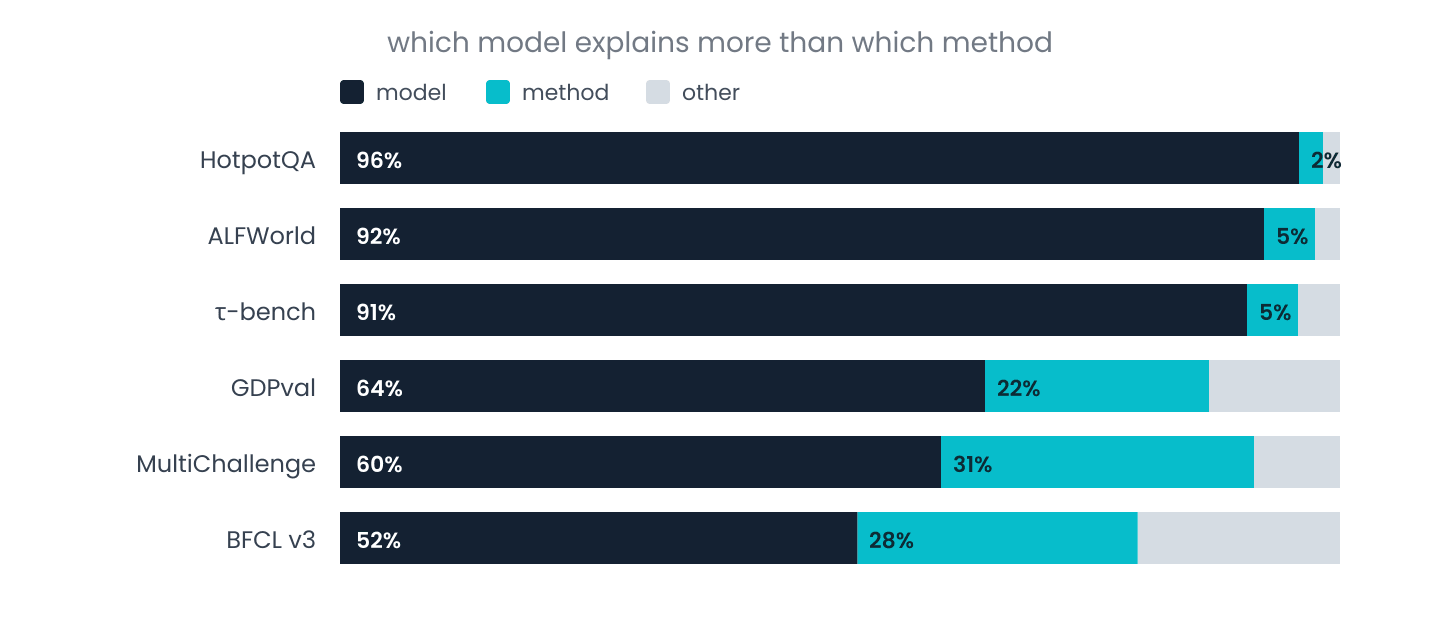
Share of the variation in results explained by each factor, computed by us from Table 1 of Lu et al., 2026.
So we do not claim that structure beats the model. On this evidence, it does not. The claim is narrower: structure is a consistent second effect, and the one you can keep, inspect and correct.
A model behind an interface does not keep what it learned on your work. A graph does.
The bird was foraging
The line we first wrote for this piece was about the bird. It was not stupid; it was explaining a pattern that was not there, and so was our rule.
Staddon makes it sharper. The bird may have been explaining nothing at all. It was foraging on a timer, and the explanation was ours.
That is where we now place the risk: in the reader of the learner, not the learner. The law keeps the graph honest. Our job is to stay honest when we read it.
Sources
Scott Aaronson, NP-complete Problems and Physical Reality, ACM SIGACT News, 2005 (arXiv:quant-ph/0502072).
Toshiyuki Nakagaki, Hiroyasu Yamada and Ágota Tóth, maze-solving by an amoeboid organism, Nature, 2000. Atsushi Tero and colleagues, rules for biologically inspired adaptive network design, Science, 2010.
Atsushi Tero, Ryo Kobayashi and Toshiyuki Nakagaki, A mathematical model for adaptive transport network in path finding by true slime mold, Journal of Theoretical Biology 244, 2007. Vincenzo Bonifaci, Kurt Mehlhorn and Girish Varma, Physarum can compute shortest paths, 2012.
B. F. Skinner, “Superstition” in the pigeon, Journal of Experimental Psychology, 1948. John Staddon and Virginia Simmelhag, The “superstition” experiment, Psychological Review 78, 1971.
Yuxing Lu and colleagues, Procedural Graphs, arXiv:2609.09153, 2026. Hao Shi and Xi Li, Topological Necessities, arXiv:2609.11014, 2026.
Common questions
What is a learning rule?
A law that changes what a system prefers from what happened to it, without anyone setting the preference by hand.
What did Staddon and Simmelhag find?
Repeating Skinner’s experiment with second-by-second records, they found the birds’ behaviour was organised by the timing of the food. It was largely typical of the species, not rituals stamped in by coincidence.
How does your rule resist superstition?
Food is measured against the usual score for the class of work, so a link that is merely present earns nothing. Food is spread over the path walked, so detours earn less. A link whose food keeps changing sign is read as the prior.
Does the platform matter more than the model?
Not on the evidence we checked. In the procedural-graphs paper, the model explains most of the variation. Structure adds a consistent, smaller gain that can be kept and corrected.
Related writing
- Nobody Types the Weights. The three ways a weight can move, and the one that is locked.
- Limitations, Perceived and Real. The pigeon at the keyboard: seven of eight reported limits were never there.
- A Hand-Written Map Can Be Worse Than No Map. Why the correction loop matters more than the map.
- Independent Convergence. How we log outside work that reaches the same place.