Architecture & Method
Nobody reads it.
The work asks it.
A wiki is knowledge you go to. Working knowledge is knowledge you look through. The difference decides whether an AI agent uses what your company knows, or ignores it.
Knowledge is working knowledge when the answer arrives inside the task that needs it, without anyone leaving the task to fetch it. A wiki holds knowledge you go to. A working record holds knowledge the job asks for, at the moment it is needed, in the amount it needs.
The probe
A person feeling their way with a stick does not attend to the stick. They attend to the ground, through it. The stick is there, in the hand, doing all the work, and it is invisible while it works. It becomes an object of attention only when it breaks.
Michael Polanyi used this example in 1958 to separate two kinds of awareness: the thing you attend to, and the things you attend from. Skilled work runs on the second kind. The tools, the rules, the known facts are all attended from. Nobody stops to read them.
A wiki is attended to. You leave the task, open a page, read, come back and try to hold what you read while you work. That is the shape of every knowledge base most companies run, and it is why the AI never opens it either.
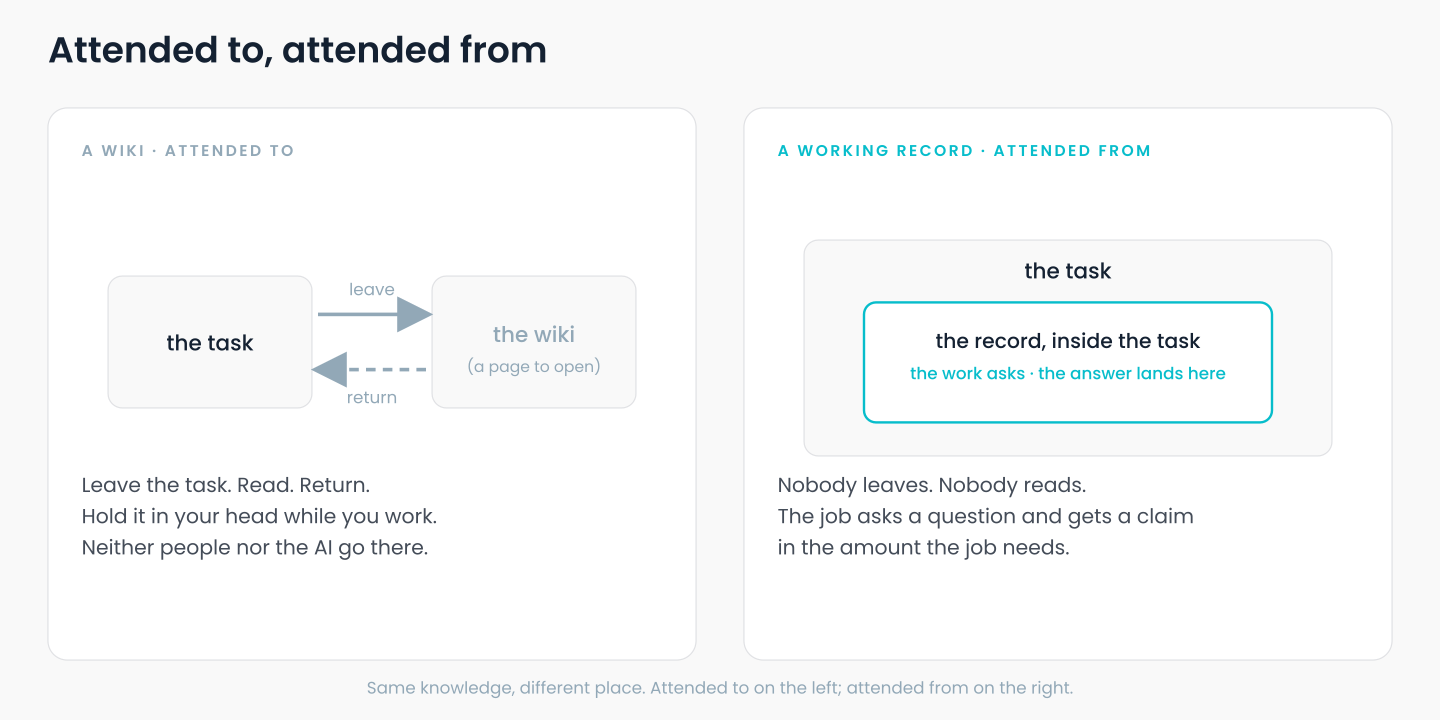
Attended to, on the left. Attended from, on the right. Same knowledge, different place.
Every session starts in the middle
An AI agent has no yesterday. It starts each job inside a company's history that it did not live, with a model's priors in place of the company's.
Charles Sanders Peirce wrote the rule for this in 1868, about people: we cannot begin with complete doubt; we must begin with all the prejudices we actually have. For an agent, the prejudices it actually has are the model's. The prejudices it should have are the company's: what has been decided, what holds, what was tried and failed.
So the first act of a job is a lookup, never a guess. The agent asks the record what it holds for the question at hand. What comes back is the company's prejudices, declared, dated, and attributed, in the amount the job needs.
That last clause matters more than it sounds. A Hand-Written Map Can Be Worse Than No Map covered the measurement: in Google's procedural-graphs study, giving an agent its whole map scored 54.48 at 96,360 tokens per task. Showing it only the two steps around its position scored 81.53 at 28,064. Having no map at all scored 72.58.
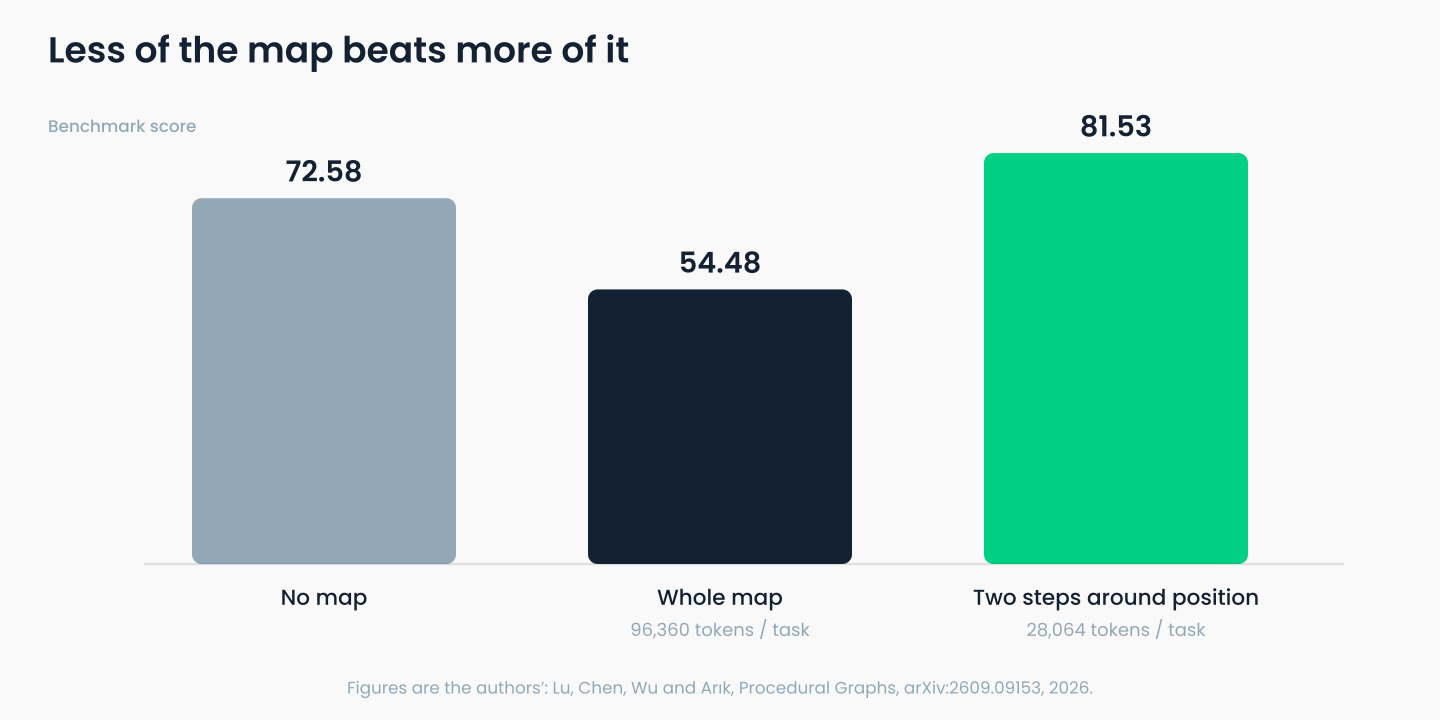
The whole map is attended to, and it hurts. The two steps are attended from, and they help. Figures are the authors'.
More knowledge, read, made the agent worse than ignorance. Less knowledge, delivered at the point of use, beat both. The probe works when it is in the hand, not when it is on the desk.
The loop opens on breakdown
The stick becomes visible when it breaks. The same is true of a claim.
A rule that is working is attended from. It shapes the job silently and earns, or fails to earn, from the outcome, as described in the pigeon article. Nobody looks at it. Then an outcome contradicts it. The job that followed the rule scored below its class, or the fact it rested on was overturned, or the decision behind it was replaced.
At that moment the claim becomes an object. It surfaces, with its history, for someone to re-decide. John Dewey described inquiry this way in 1938: it opens in a situation that has become problematic and closes when the situation is settled. Nothing opens it except the problem. Nothing closes it except a decision.
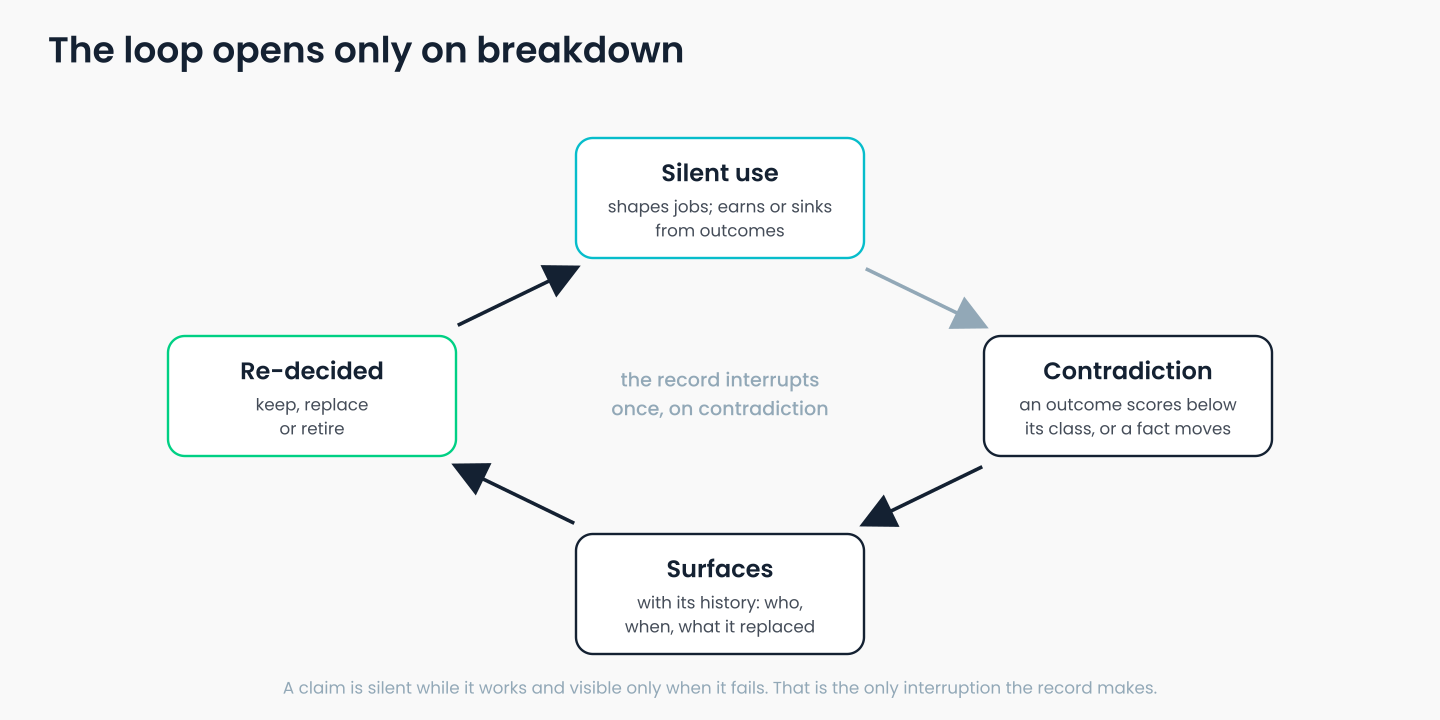
A claim is silent while it works and visible only when it fails. That is the only interruption the record is allowed to make.
This is the discipline most knowledge tools lack. They either interrupt constantly, with notifications, digests and reminders nobody reads, or never, so a stale rule keeps shaping work for a year. The record interrupts once, on contradiction, with the evidence attached.
Where we are short
Two places, and both are published.
Our correction loop is still open. The part of our system that proposes changes to our own knowledge pages runs at volume; as of 22 September it had rejected 1,072 proposals, held 291 and promoted 22 in a day. The part that measures whether a promotion helped had measured six. Until that closes, our pages are a hypothesis with a good delivery mechanism.
Our graph is young. Of the 444 links fed under the current learning rule by 23 September, thirteen had earned a positive average. The rest sit near where they started. Delivery at the point of use is working; the record has not yet seen enough work to rank what it delivers by what it earned.
Neither is a reason to go back to the wiki. Both are reasons to say what the record is today: the right shape, under-fed.
What this means for an AI tool
Three rules, each a test.
Knowledge is pulled, not pushed. A job asks; the record answers with what is relevant to that question and nothing else. No page is ever loaded "in case".
The record interrupts only on contradiction. A claim surfaces when an outcome contradicts it, and at no other time. No digests, no reminders.
A claim arrives with its history. What was decided, by whom, when, and what it replaced, so the re-decision is made with the record and not from memory.
An agent that works this way does not read your company's knowledge. It works through it, the way a hand works through a stick, and notices it only when something breaks.
Common questions
Why not just give the agent the whole knowledge base?
Because it reads all of it as instruction. In the procedural-graphs study, the whole map scored below having no map. Guidance gets followed, including the parts that don't apply.
How is this different from retrieval over documents?
Retrieval finds passages. A working record returns claims: typed as fact, rule or decision, with a source, a name and a date, ranked by what they earned in use. The agent gets a claim it can act on, not a page it has to interpret.
What if the record is wrong?
Then a job that followed it scores below its class, the claim surfaces with that evidence, and someone re-decides it. A wrong claim in a wiki stays wrong until a person happens to read it.
Does this replace documentation?
It replaces the act of documenting. The record is written as a side effect of work; nobody opens a page to write a handover. The knowledge still exists. The chore does not.
Sources
Michael Polanyi, Personal Knowledge (1958), ch. 4, on subsidiary and focal awareness. Charles Sanders Peirce, "Some Consequences of Four Incapacities," Journal of Speculative Philosophy 2, 1868. John Dewey, Logic: The Theory of Inquiry (1938), ch. 6, "The Pattern of Inquiry." Yuxing Lu, Yicheng Chen, Shanchan Wu and Sercan Ö. Arık, Procedural Graphs, arXiv:2609.09153, 2026.
Related writing
- A Hand-Written Map Can Be Worse Than No Map. The measurement behind "less of the map".
- A Decision Is Not a Fact. The three kinds of claim the record holds apart.
- context-steward. The library that loads skills on demand instead of up front.
Learning rule series · 10 of 10
← A Decision Is Not a Fact · Start again: A Hand-Written Map Can Be Worse Than No Map →
What this means for your company. Your knowledge is in a place people go to, so neither your people nor your AI go there. The Knowledge Layer is asked by the work, answers inside the task, and interrupts only when a claim is contradicted.
Knowledge Layer →