Bad poets deface what they take
November 2026 · Bouletteproof engineering
In 1920, T.S. Eliot wrote the line that programmers later shortened to “great coders steal”:
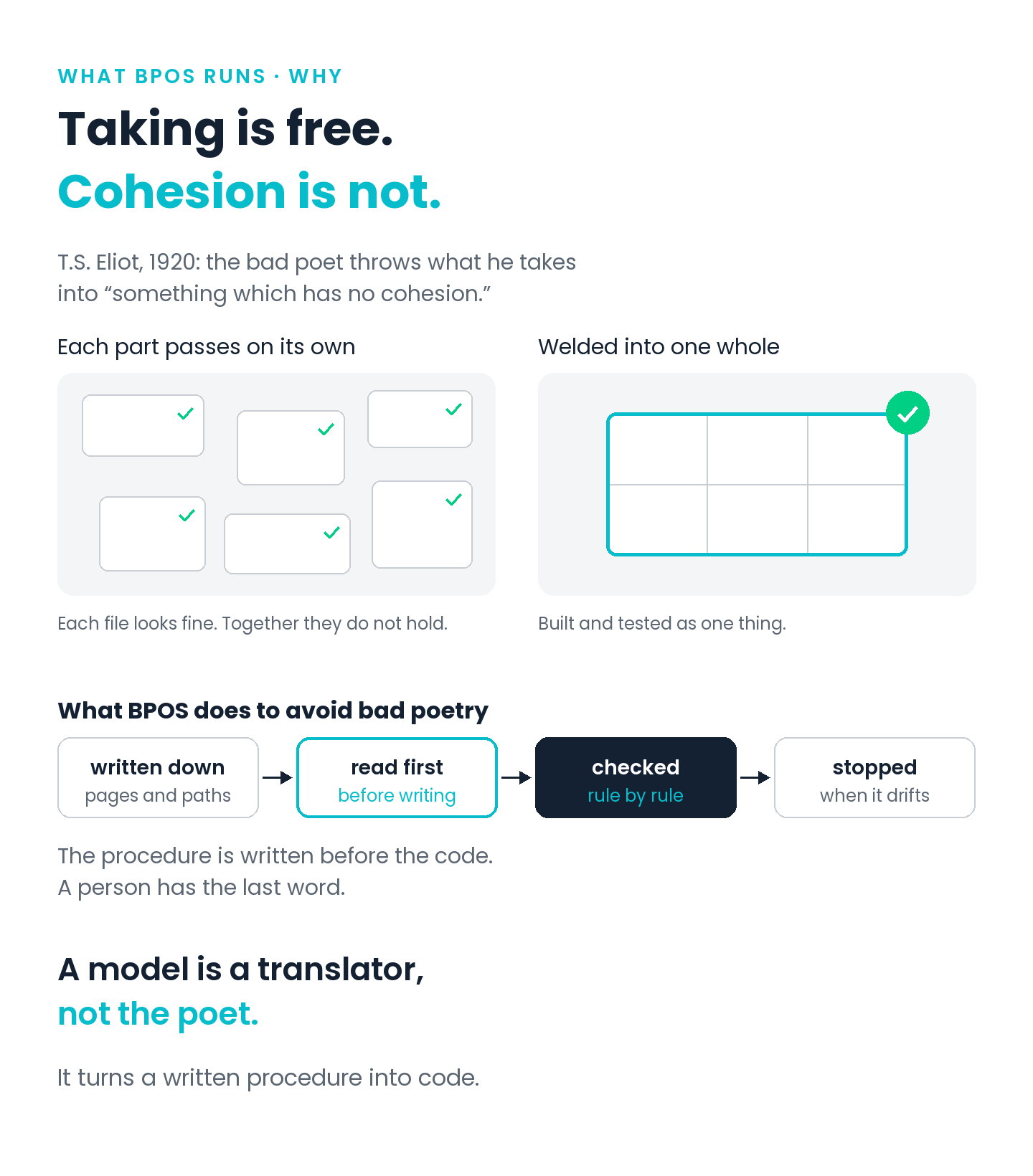
“Immature poets imitate; mature poets steal; bad poets deface what they take, and good poets make it into something better, or at least something different. The good poet welds his theft into a whole of feeling which is unique, utterly different from that from which it was torn; the bad poet throws it into something which has no cohesion.”
— “Philip Massinger”, The Sacred Wood
Let that sink in for a moment: it describes AI-written code.
Taking is free now
A model has read more code than any person will. It takes from all of it, in seconds, for almost nothing. Taking was never the hard part, and now it costs nothing.
What a model does not have is your whole: the decisions you already made, the things that already failed, the rules your software has to meet. So each file it writes looks fine, and the files do not hold together. That is Eliot’s bad poet, at machine speed.
1972: the machine does not make the band
Musicians had this argument fifty years ago. In 1972 Pink Floyd were filmed at Abbey Road, recording The Dark Side of the Moon, and were asked whether their machines made the music for them. Roger Waters said it was like saying “give a man a Les Paul guitar, and he becomes Eric Clapton”. It is not true, he said, and an amplifier and a synthesizer do not turn anyone into Pink Floyd either. David Gilmour said he did not think the equipment could take over.
From the Abbey Road interviews in Pink Floyd: Live at Pompeii, directed by Adrian Maben.
Half of that still holds. A model does not make an engineer, any more than a Les Paul makes a guitarist.
The other half does not. A synthesizer played only what it was patched to play. A prompt never says everything. Ask for a login page and many decisions are left open: where the file goes, which library to use, how errors are handled, what things are called. The model fills in the rest from what it learned elsewhere, and nobody wrote that part down. Where it learned too little, it makes something up.
We do not use models for their creativity. To us a model is a translator: it turns a written procedure into code. So whatever it must not invent has to be written down first, checked afterwards, and stopped when it drifts. Which instructions work is measured from the results, not left to the model’s taste.
In 1637 Descartes gave the rule every engineer still follows: divide each difficulty into as many parts as it takes to solve it. Descartes tells you how to cut. He does not tell you how to weld.
What BPOS does to avoid bad poetry
The whole is written down. How the work gets done is kept as pages anyone can read, and as the paths between them. We call it the procedural graph. See Procedural memory for AI agents.
Reading comes before writing. Before starting, each AI worker reads what this job needs, and only that. See What an AI agent reads before it acts.
Every job has written rules. Each rule is checked, then the build and the tests run. What the rules do not name is not checked, so the rules have to be good. See Every job is a contract and The quality gate.
A job that stops getting closer is stopped. It is flagged for a person, not retried forever. See When to stop an agent loop.
A person has the last word. See Where a person decides.
The poet is not the model
When a job is done, the workers that did it are gone. What stays is the path they took: which instructions they followed, and whether it worked. Paths that led to good work get stronger. Paths that led to a stopped job get weaker. See Nodes, not agents.
So the knowledge of how your software holds together is not inside a model. It is in pages and paths you can read. A better model is a swap, not a rebuild.
Models made taking free. What is left to pay for is cohesion: software whose pieces still fit a year later.
See it step by step. One goal followed through BPOS: planned, built, checked, and learned from.
How BPOS builds software →Next. What it takes to keep the parts that worked and redo only the one that failed.
Two watchmakers: keep what held, redo what failed →