Two watchmakers: keep what held, redo what failed
November 2026 · Bouletteproof engineering
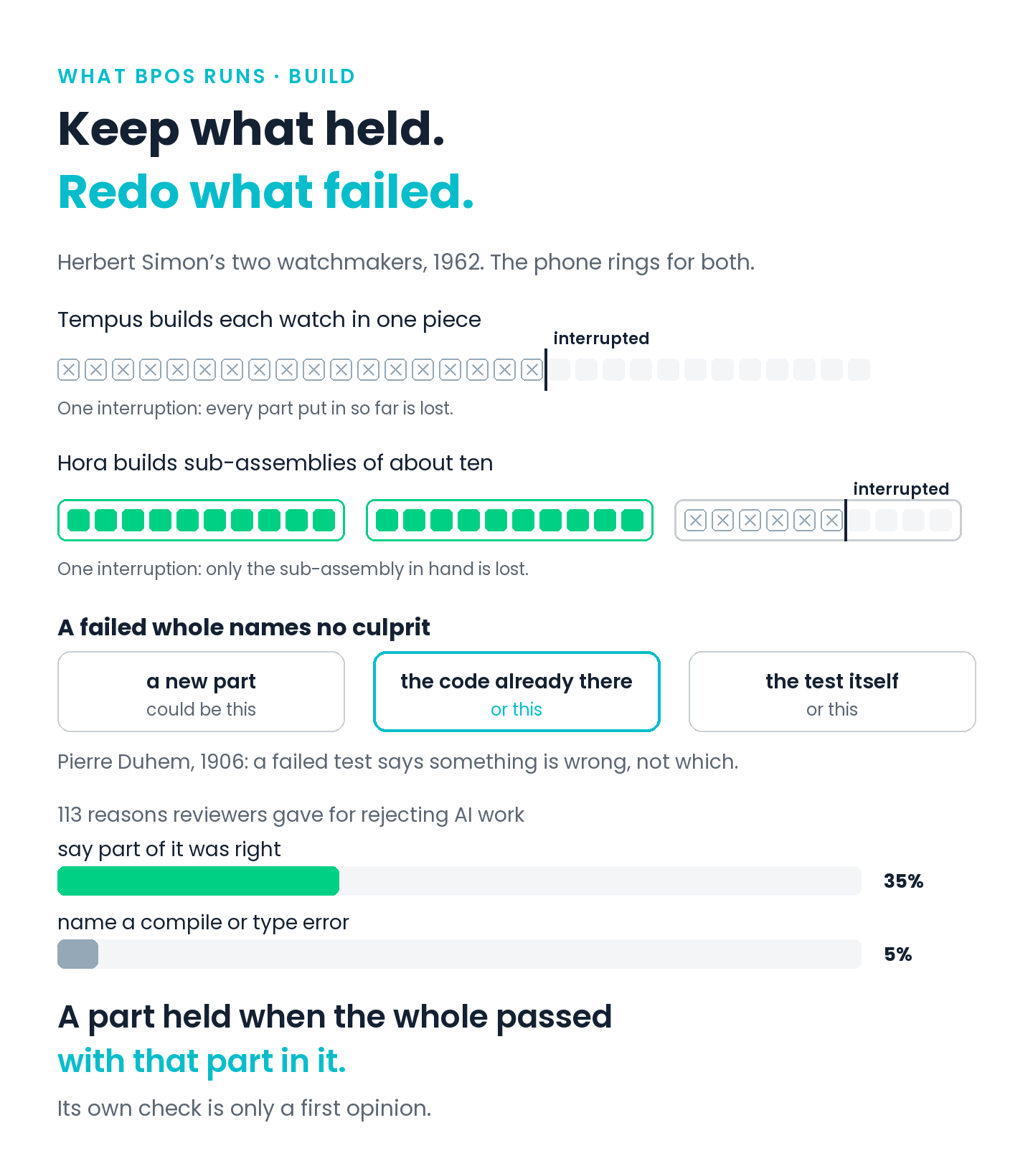
“Keep what held, redo what failed” is a rule for work done in parts: when one part fails, only that part is done again. It makes a failure cheap. It only works if you can say which parts held, and that is harder than it sounds.
Hora and Tempus
In 1962 Herbert Simon told a story about two watchmakers, Hora and Tempus. Both made fine watches of about a thousand parts. Both were interrupted all day by the telephone.
Tempus built each watch in one go. When he put a half-built watch down to answer the phone, it fell to pieces, and he started again from the first part. Hora built his watches from small sub-assemblies of about ten parts. Each one held together when he put it down. A phone call cost him the one he had in his hands and nothing else.
Hora prospered. Tempus lost his shop. Simon’s conclusion was that how fast anything complex gets built depends on its “intermediate stable forms”: the pieces that hold on their own along the way. He put numbers on the story, then warned his readers not to take the numbers seriously. The shape of the argument is what lasts.
We were Tempus once
An AI system that fails and starts the whole job again is Tempus. We know because we were. In one case from our own records, a reviewer’s rejection re-ran a job, the re-run failed, and the rollback went back to before the job had ever run. Work that a person had reviewed and approved was erased. The full story is in From 47 minutes to 6 seconds. Since that day, approved work stays on disk.
Starting over also throws away good work. We read 113 reasons our reviewers gave for rejecting an AI worker’s output. In 40 of them, about 35%, the reviewer said that part of the work was right. Only 6, about 5%, named a compile or type error. The details are in The blast radius of a change. When a third of rejected work is partly right, redoing all of it is the expensive way to fix it.
Building like Hora
BPOS, the platform we build our software with, cuts a goal into stages. Each stage has a check that says when it has landed. A stage is cut into jobs, and a job writes one bounded thing. Lite, our knowledge layer, was built this way: six stages, 19 sprints, 29 jobs. See A goal has necessary stages.
Each landed stage is one of Hora’s sub-assemblies. When a job fails, the stages that landed are not touched. The failed job is done again, and the rest is kept.
The catch: a failure names no culprit
Simon’s story assumes you know which sub-assembly broke. In 1906 the physicist Pierre Duhem explained why you often do not:
« Le physicien ne peut jamais soumettre au contrôle de l’expérience une hypothèse isolée, mais seulement tout un ensemble d’hypothèses ; lorsque l’expérience est en désaccord avec ses prévisions, elle lui apprend que l’une au moins des hypothèses qui constituent cet ensemble est inacceptable et doit être modifiée ; mais elle ne lui désigne pas celle qui doit être changée. »
— Pierre Duhem, La théorie physique, son objet, sa structure (1906)
In plain English: an experiment never tests one idea alone, only a whole group of them. When it fails, it tells you that at least one of the group is wrong. It does not tell you which.
Duhem was writing about physics, not software. But a build is the same kind of test. When the whole fails, at least one thing is wrong: one of the new parts, or the code that was already there, or the test itself. The red light does not say which. Blaming the part that was written last is a guess.
A green light has the same weakness. It says the parts passed together. It does not certify each one, and a part can pass by luck. That is the subject of The Gettier problem for AI agents.
So what does “held” mean?
A part passing its own check is not enough. Two parts can each pass alone and fail together: one calls a function the other was supposed to add. Kept on its own, the first part is one of Tempus’s loose pieces that only looks like a sub-assembly.
The stricter answer is that a part held when the whole was built and tested with that part in it and the failed part taken out. Its own check is a first opinion. The whole is the verdict, and even that verdict covers the parts as a group.
Here is where we are. Since 19 November 2026 BPOS works by the stricter answer inside a job. When the tests pass, every file of the job is recorded as it stands, and a failed attempt goes back to that state, not to the start. Two things are not built yet: checking, before a part is kept, that it does not depend on the part that failed; and narrowing down which part broke a failed whole. This has been running for less than a day, so we have no figures to publish.
Questions
What is a stable intermediate form? A piece of unfinished work that stays whole when you stop: a sub-assembly, a stage that has landed, a file that builds. Simon’s point is that complex things get finished when they are made of such pieces.
Why can’t a failed test tell you which part failed? Because the test ran on everything at once. It shows that the group is wrong somewhere. Finding where takes more runs, with parts taken out one at a time.
What does this change for a business? A failure costs one part instead of the project, and work a person has approved is not lost to someone else’s mistake.
Sources
- Herbert A. Simon, “The Architecture of Complexity”, Proceedings of the American Philosophical Society 106(6), December 1962.
- Pierre Duhem, La théorie physique, son objet, sa structure, 1906, part II, chapter VI. The English rendering is ours.
- Our own records, as published in the articles linked above.
Where this starts. Parts that pass alone and do not hold together are what T.S. Eliot called bad poetry.
Bad poets deface what they take →