What BPOS runs · Execute
Before it acts, a node reads.
In a turn of its own.
Deciding what an agent reads is most of what is now called context engineering. In BPOS the node decides, in a turn that does nothing else. Three attempts to make it decide as a side task failed; this is what replaced them, and what it costs.
Before a BPOS node plans anything, it takes a turn whose whole output is its perception: which pages it will open, which instruments it will read, and why, or that it is ready. The platform serves each choice and records it, and the links the node used are reweighted by the outcome of the job.
This article belongs to What BPOS runs. It follows An agentic mesh in every job, which covers how nodes talk, and The blast radius of a change, which covers what a node should read.
The choice in front of every node
A node arrives with the page that makes it what it is. Around it is more than it could ever read: the pages linked to its own, each link carrying the weight the record has earned it; search results, ranked by relevance and trust; instruments that read the workspace for it, such as a file, a symbol's references or a claim in the knowledge graph; and what earlier nodes produced. Giving it everything would bury the few things that matter. Giving it nothing would leave it guessing. So it has to choose.
Three attempts that scored zero
We first tried to make the choice a side task of the main work. Every version was measured, and every one scored zero.
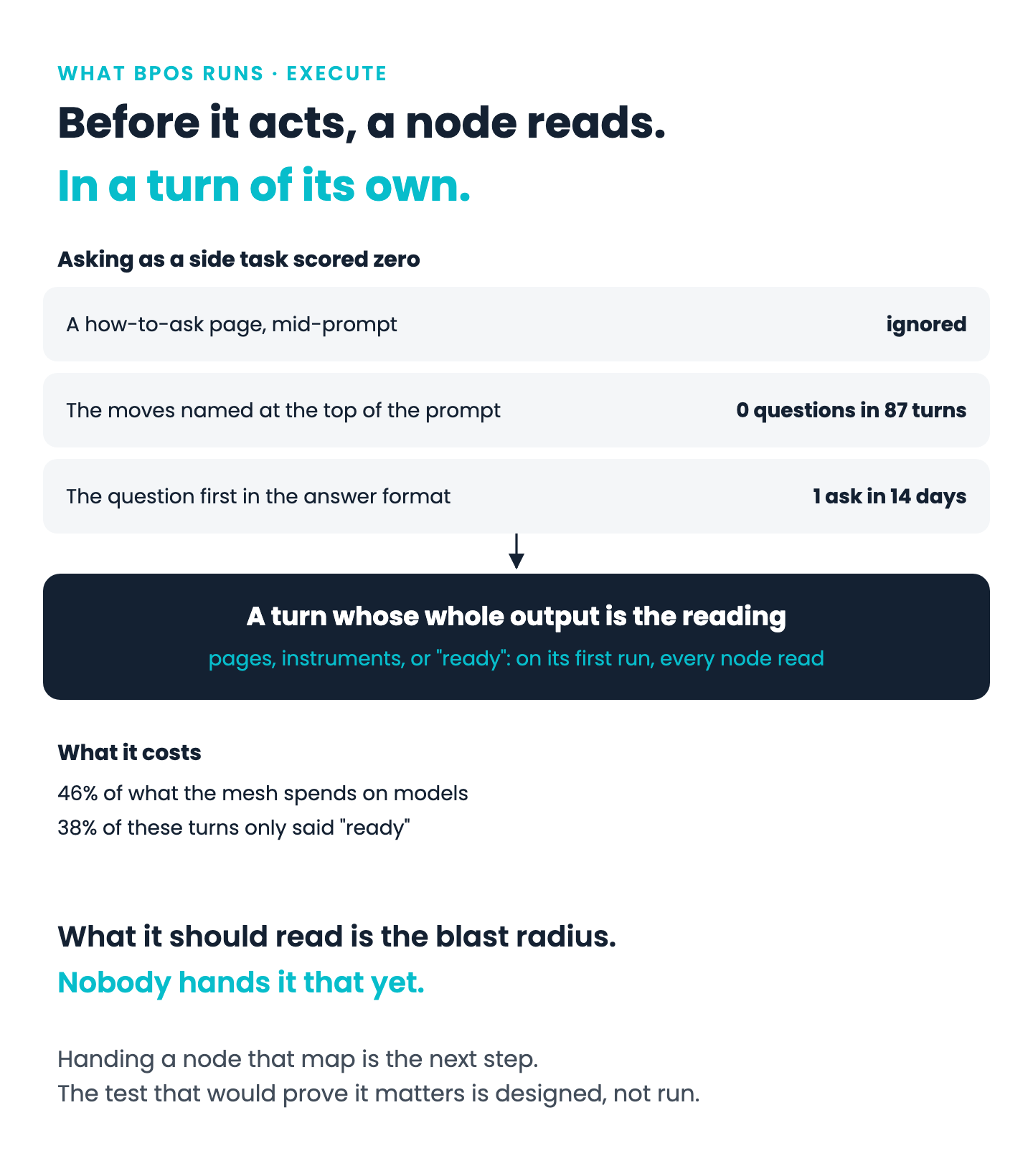
- A page on how to ask. Placed 15,200 bytes into a 34,678-byte prompt, it was outranked by the node's own objective and constraints. The node that received it did not ask.
- The moves at the top of the prompt. The job's frame, COCA, began naming the moves a node could make, ask or say it is blocked, in the part of the prompt that outranks the rest. In the 21 days that followed, 87 worker turns met exactly the situations the moves were for: 84 had been promised a reading that was never delivered, and 3 needed names that resolved nowhere. Not one asked a question.
- The question first in the answer. We moved the question field ahead of the content in the answer format. One ask in 14 days.
On 18 September we went further and offered every node a list of pages it could open. The offer was present in all eight turns of the run that tested it, and nobody opened one. The lesson was consistent: a model asked to choose its reading as a side effect of producing something else does not choose.
A turn of its own
The same day, we gave the choice a turn of its own. Before the node plans, it answers one question and nothing else: what will you open, what will you read, and why, or are you ready? The platform serves each choice, pages within the node's budget and instruments through the platform, and the node plans with what came back. On its first run, every node read.
The turn sets no weights. Every page a node opens is recorded as a hop on the path the job walked, and when the job's outcome is known, the hop is reweighted by it like any other. So the choice of what to read is itself learned, by the same rule as the rest of the procedure. The turn also has its own thinking depth, separate from the planner's, and it is shown what the job has already established before it chooses, so it does not read what is already known.
Two frames, one node
We call the turn µ-COCA, and it is not COCA. COCA is the job's frame, Context, Objectives, Constraints and Action, built once per job and placed at the top of every prompt, as Every job is a contract explains. µ-COCA is the node's own: it takes what reaches this node, weighted by what the record has earned, and builds what this node does. In the neuron analogy the design follows, it is the cell body that integrates the incoming signals. Reading is its first function.
What it costs
In the two weeks to 8 October, the reading turn ran 6,960 times and took about 46% of everything the mesh spent on models, priced at the providers' list prices, the largest single share. And 38% of those turns only said "ready". A reading and "ready" almost never come back in the same turn, so a node that reads pays one more full turn to say it has finished. A yes-or-no decision is being paid for as a full reasoning turn.
Two fixes are ruled out. A rule in our code that decides when a node is ready would be a judgement about meaning hard-coded where meaning does not belong. Prompting harder would repeat the three attempts above. The direction is a different kind of part for yes-or-no decisions, and we have not chosen one yet: a candidate has been reviewed and is not to be tried until its cost, speed, data terms and a replay against the stored "ready" turns are known.
What it should read
Today a node chooses from what it is connected to. What it should read, when it changes something, is the blast radius of that change: the dependencies of what it touches, one level up. Reviewers reject agents' work far more often for what a change failed to reach than for code that is wrong, and the blast radius is exactly that reach. It is not handed to the node yet. Handing it over is the next step, and the test that would show it matters, whether rejected attempts read less of their blast radius than approved ones, is designed and not yet run.
- Not yet measured: whether a node used what it chose to read. The planner's citations are recorded; the reading turn's are not yet.
Common questions
What does an AI agent read before it acts?
In BPOS, each node is offered pages linked to the one it holds, search results, instruments that read the workspace, and what earlier nodes produced. Before it plans, it takes a turn whose whole output is what it will open and read, and why, or that it is ready.
Why not give an AI agent everything to read?
Because a node that takes in everything does nothing in particular, and its context fills with material that outranks nothing. BPOS offers a node what it is connected to, lets it choose, and records the choice so the links it used are reweighted by the outcome.
What is µ-COCA?
BPOS's per-node frame. Where COCA is built once per job and placed at the top of every prompt, µ-COCA is built by each node from what reaches it, and its first function is the node's reading turn.
Sources
- Our own records: the measured attempts of September 2026; the reading turns and model spend in the two weeks to 8 October 2026.
Related writing
- The blast radius of a change. What a node should read.
- An agentic mesh in every job. How nodes talk, and the neuron analogy.
- Every job is a contract. The job's frame, COCA, and its Action.
- Nodes, not agents. The cost of perception against the rest of the mesh.