What BPOS runs · Execute
An agentic mesh in every job.
Nodes built like neurons.
A job in BPOS is not done by one agent. It is done by a small network of nodes that listen to each other, publish to each other and ask each other. This is how they communicate, and the neuron analogy the design is built on.
In BPOS every job is worked by an agentic mesh: a set of small nodes, each declaring what it listens to, what it publishes and what it needs from the others. Nodes fire when what they wait on has arrived, so independent work runs together in waves. Each node is generic until the skillset it loads decides what it becomes, the way a neuron becomes a particular cell.
This article belongs to What BPOS runs. Its companion, Nodes, not agents, covers how a node becomes an agent for one stage and why we keep what it did instead of the agent.
Two meanings of agentic mesh
In June 2025, McKinsey's QuantumBlack unit argued in Seizing the agentic AI advantage that companies need a new architecture, which it called the agentic AI mesh, to govern many agents across a business: blending agents a company builds with ones it buys, and keeping the risk and the technical debt under control. That is a mesh across a company's agents.
We use the word one level down. In BPOS the mesh is inside every job: the small network of nodes that does one piece of work. Both meanings are right at their level, and they share the same idea: many specialised parts that connect, instead of one general part that does everything.
What a node declares
A node is a small unit of work with a few declarations, and nothing else is assumed:
- The channels it waits on before it may fire.
- The channel it publishes to when it is done.
- Its objective and its constraints.
- The names it produces and the names it requires: a contract with the other nodes, so a node that needs a function knows which node will declare it.
- Its lane: code written by a model, analysis, or an allowed action with no model at all.
The bus that carries the messages has a one-line description in our code: agents are nodes, skills are edges, and the transport is a message broker.
How nodes talk
They fire in waves. A node fires when everything it waits on has been published. Nodes that do not depend on each other therefore run together, and when two of them in the same wave declare the same name, the collision is caught.
They write only their own part. A writing node returns the new content of its own region of a file, under a fixed answer format. The rest of the file is not its to touch.
They can ask. When a node is missing something, its question is answered from the closest reliable source first: the page it was offered, an instrument that reads the workspace, a link it followed, and then a peer. A peer does not send its code or a summary of its thinking. It sends a pointer: the file and region it wrote, the skill it held, what it declared, and whether it compiled. A peer that has not finished yet says what it intends. A pointer beats a paraphrase.
They can refuse. A node whose instructions cannot all be satisfied says so, and the job goes to review with the conflict stated, instead of producing code that cannot be right.
The neuron analogy
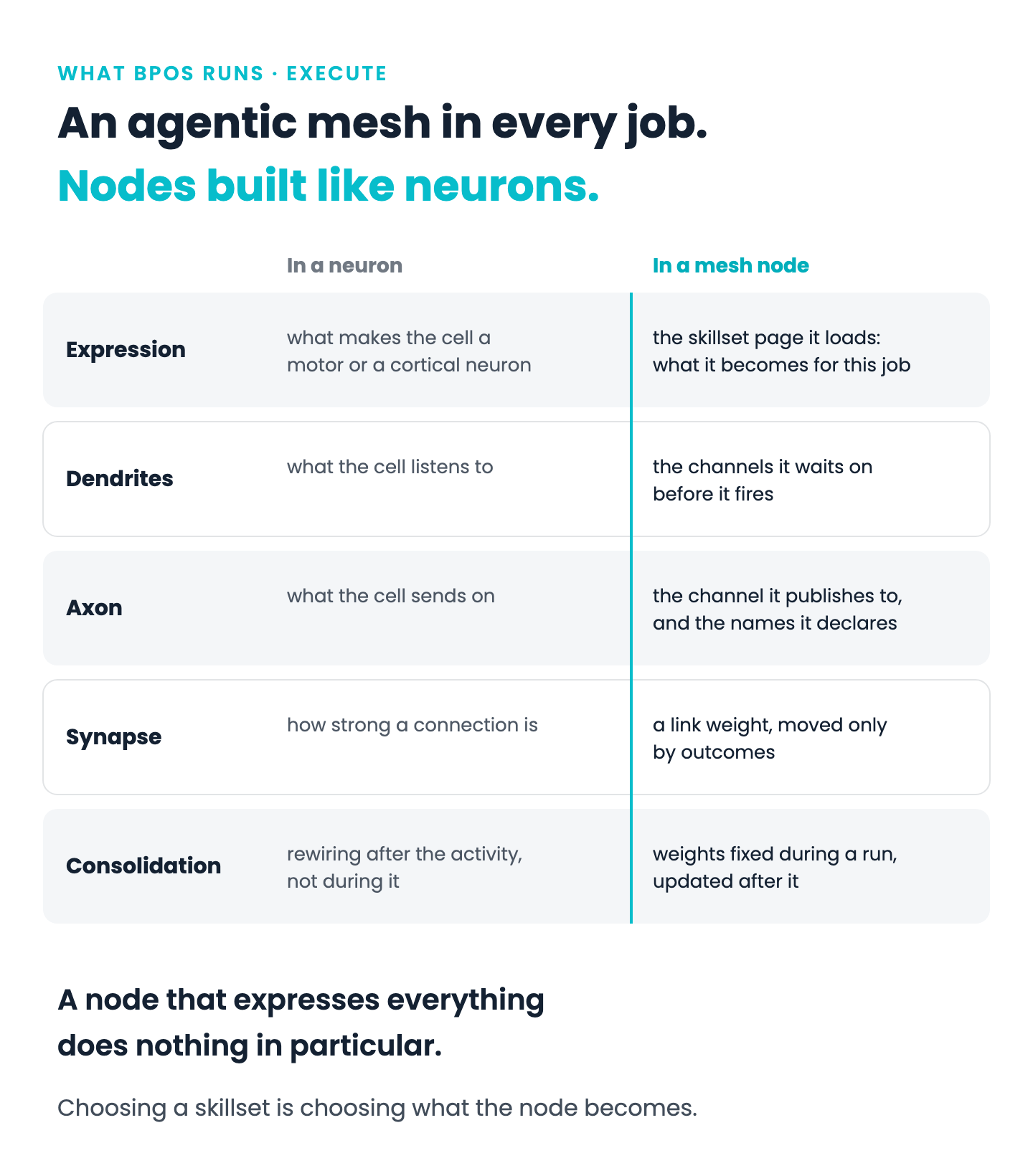
We do not use the neuron as a metaphor. It is the frame the design follows. A neuron is generic machinery. What makes one a motor neuron and another a cortical one is what it expresses and what it is connected to, not the cell body. A mesh node is the same: generic compute with a channel, until a skillset decides what it becomes.
- Choosing a skillset is specification, not retrieval. It is not choosing what a node will read; it is choosing what the node becomes. A wrong skillset is the wrong kind of cell in the wrong place.
- A node that expresses everything does nothing in particular. Giving a node every page it might use dissolves what makes it specific, which is why a node carries a few pages, not many.
- Connections are synapses. The links between pages carry weights, and the weights move only with outcomes, as Procedural memory for AI agents explains.
- Rewiring happens after, not during. Weights are fixed while a run is under way, so each outcome can be traced to the connections that produced it, and they are updated afterwards.
- The links form a connectome, not a reading list. They describe how a differentiated system is wired.
Where it falls short
- Most of the connectome is not wired yet. Of 261 active pages, 173 declare no outgoing link at all, so most cell types cannot be reached from the others. On 25 August it was 105 of 128. It is better, and it is still most of them. In the 30 days to 10 October, 121 pages were used at least once.
- Most nodes are still the same kind of cell. Every skillset runs on the same default pair of models today; only stages that produce images or video name their own. The differentiation is in the procedure more than in the machinery.
- Perception is expensive. Each node takes a turn to choose what to read before it acts, and those turns are the largest share of what the mesh spends on models. Nodes, not agents gives the numbers.
Common questions
What is an agentic mesh?
A network of AI agents that work through shared connections rather than one agent doing everything. McKinsey uses the term for an enterprise architecture that governs many agents across a company. In BPOS it is also the structure inside each job: a set of small nodes that listen and publish to one another.
How do agents in a mesh communicate?
In BPOS each node declares the channels it waits on, the channel it publishes to, and the names it needs from and produces for other nodes. A node fires when everything it waits on has arrived, so independent nodes run together in waves. When a node is missing something, it can ask, and a peer answers with a pointer to what it wrote, never with its code.
Why compare mesh nodes to neurons?
Because a neuron is generic machinery that becomes a particular kind of cell through what it expresses and what it is connected to. A BPOS node is generic compute until the skillset it loads decides what it becomes, and the connections between pages are weighted by outcomes, like synapses.
Sources
- McKinsey & Company (QuantumBlack), Seizing the agentic AI advantage, June 2025.
- Our own records: active pages and their declared links as of 10 October 2026, against 25 August 2026; pages used in the 30 days to 10 October.
Related writing
- Nodes, not agents. How a skillset makes an agent for one stage.
- What a node reads before it acts. The reading turn every node takes.
- When to stop an agent loop. How a node's retries are stopped.
- Beyond SKILL.md. What a skillset page declares.
- Procedural memory for AI agents. How the connections learn.
- BPOS: AI agent orchestration, from a goal to shipped work. The whole machine.