Null result · July 2026
We randomised our own prompt scaffolding across 88 runs. It did nothing.
Benjamin Taini · Founder, Bouletteproof
We built the checklists. We believed in them. We measured them anyway, and they moved quality by +0.002.
Skill checklists are prompt scaffolding: reusable instructions injected into an agent's context to tell it how to do a job well — naming conventions, security rules, code style. The premise is that better instructions produce better output.
We ran the experiment. Across 88 scored executions with the checklists randomly assigned, output quality moved by +0.002. That is inside the noise. No measurable lift.
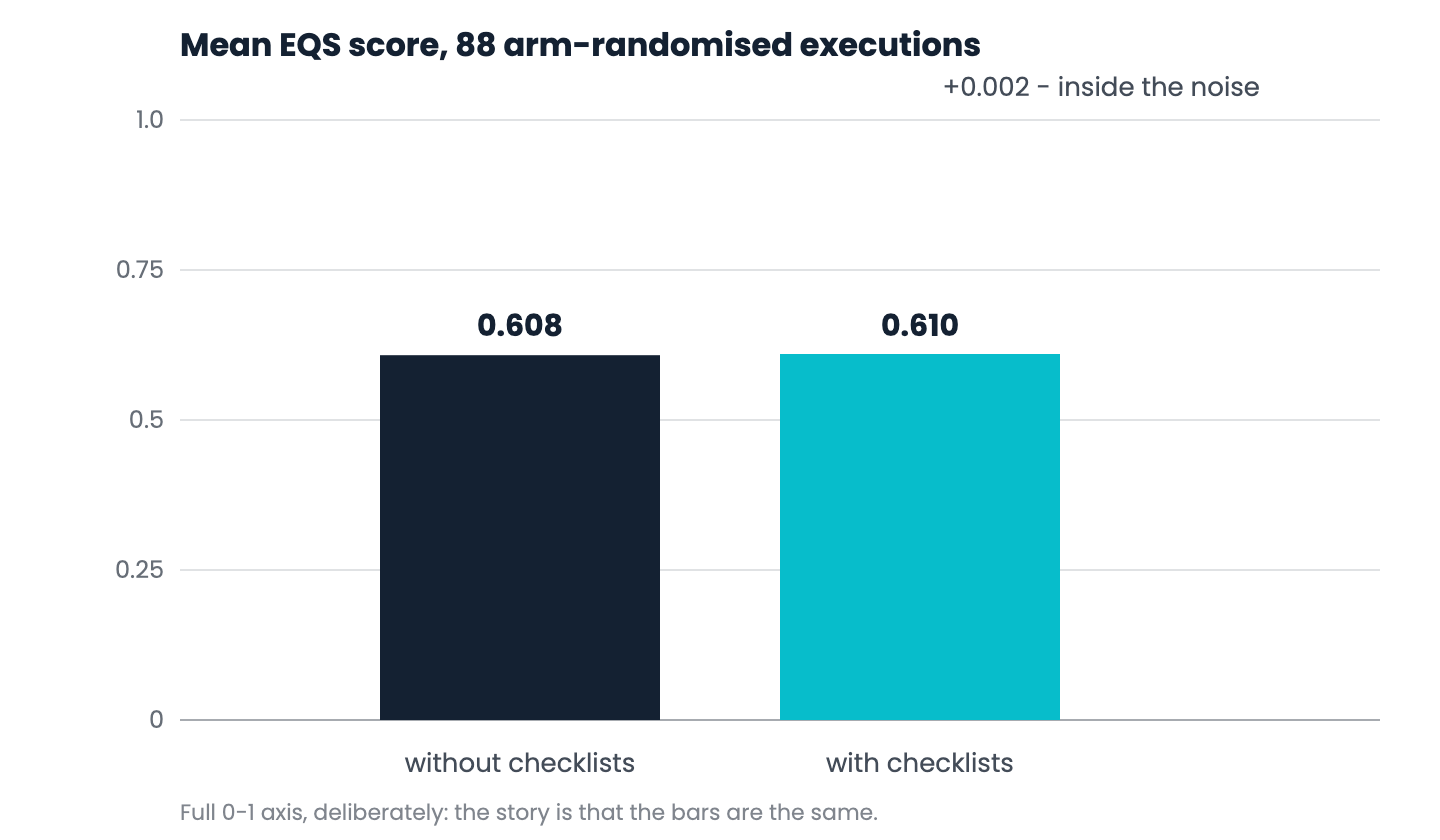
We are publishing this because we built the checklists, believed in them, and measured them anyway.
What we actually tested
Our platform runs a native skills system: a job can pull scaffolding — security rules, naming conventions, code style, documentation standards — into the model's context before it writes anything. Each execution records which skills it loaded.
The obvious way to evaluate that is to look at your history: compare jobs that loaded skills against jobs that didn't. Do it and you will find an effect. The effect will be fake.
It is fake because nothing assigned those skills at random. A human, a router, or a heuristic decided — and those decisions track job difficulty. Hard jobs attract more scaffolding. Hard jobs also score worse. The scaffolding looks harmful, or helpful, depending on which way the selection ran. You are measuring who got the treatment, not what the treatment did.
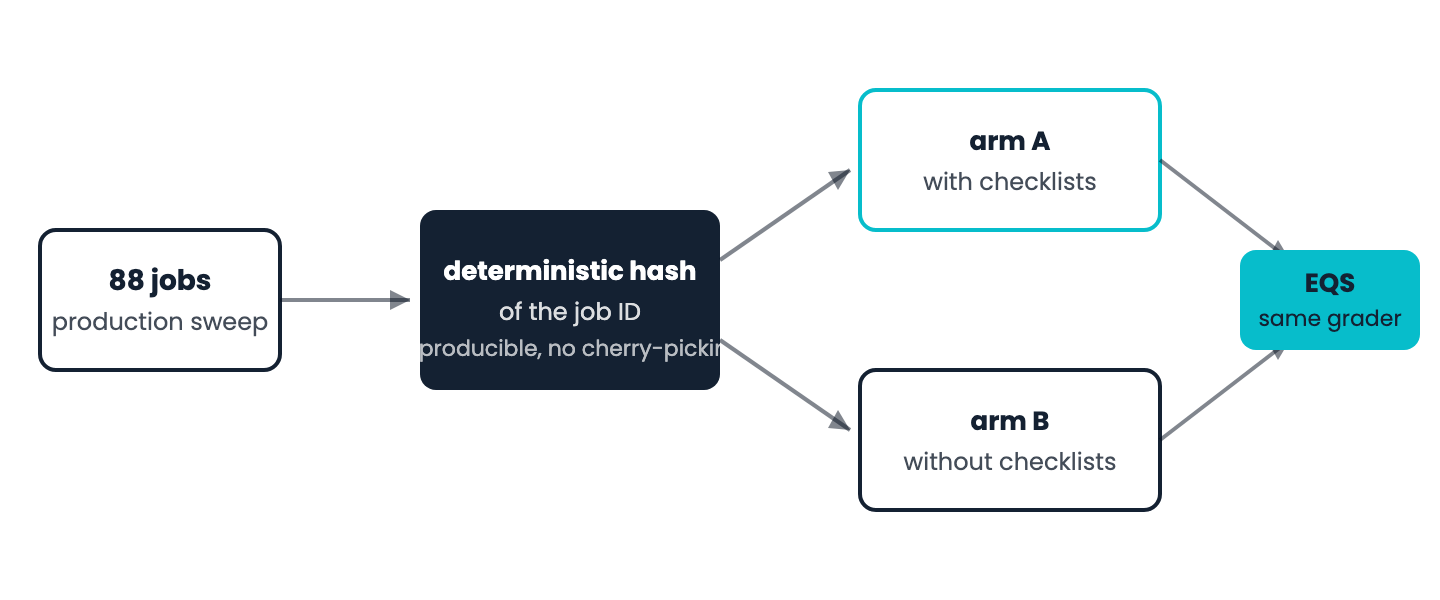
So we randomised. Each job in the sweep was assigned its arm by a deterministic hash of the job ID — reproducible, balanced, and impossible to cherry-pick after the fact. Anyone with the job IDs can recompute the assignment and check we didn't move the goalposts. Then we scored the output with EQS (Execution Quality Scorer), our grader.
Result: 0.002. Eighty-eight runs. Nothing.
Why we shipped the null instead of burying it
A negative result is worth more than the feature it kills.
The checklists cost tokens on every single execution. They cost engineering time to write and maintain. They carried an assumption — good instructions produce good code — that felt so obviously true nobody had asked it to prove itself. It didn't.
What survives is not the checklists. It is the measurement: arm-randomised intervention testing, wired into a production platform, so the next idea that feels obviously true has to earn its place. That machinery is the actual asset. The null is just the first thing it caught.
We would rather run this than tell you our agents are smart.
The boundary — read this before you quote us
This result is about our prompt scaffolding, inside our platform, scored by our grader.
It is not a finding about Anthropic's Claude Skills, or any other vendor's skills feature. Same word, different thing. We have no data on those and we are not going to imply that we do.
It is also not a claim that context never helps. It is a claim that this intervention, measured this way, did not move the number.
What we still can't tell you
- How large an effect we could have detected. 88 runs is a small sample. A tiny real effect could hide inside it. What we can say is that nothing large enough to justify the token cost showed up.
- Whether it holds for other task types. The sweep ran on our workload. Yours is different.
- Whether more context helps. We tried to answer this from our history and caught ourselves making exactly the mistake described above — the apparent effect was an artefact of who got the treatment. That question is now blocked behind a randomised experiment we're running properly. When it finishes, we'll publish the answer whichever way it lands.
Questions
What is a skill checklist?
Reusable prompt scaffolding injected into an agent's context before it works — conventions, security rules, code style, documentation standards. The premise is that better instructions yield better output.
Do skill checklists improve AI agent output quality?
In our controlled test, no. Across 88 arm-randomised scored executions, quality moved +0.002 — inside the noise. That result is specific to our platform and our workload.
Why randomise instead of just analysing past runs?
Because whatever assigned the treatment in your history also tracks job difficulty. Hard jobs attract more scaffolding, and hard jobs score worse. An observational comparison measures who got the treatment, not what the treatment did. Randomisation is what separates them.
What is EQS?
EQS stands for Execution Quality Scorer, our grader. It scores an agent execution's output from 0 to 1 against the objective and constraints the agent was given. Both arms of this experiment were scored by the same grader.
Isn't 88 runs too few?
It is small, and we say so. It rules out an effect large enough to pay for the tokens the checklists cost. It does not rule out a small one.
Does this mean Claude Skills don't work?
No. This measured our own prompt scaffolding inside our own platform. We have no data on Anthropic's Claude Skills feature and will not pretend otherwise. Same word, different thing.
Every number here comes from our execution data and is registered in our claim registry. Where we don't have a receipt, we say so. Related: The Median Trap · We Deleted Our Own Quality Checks