Essay
The Arithmetic of Absence
By Benjamin Taini · Founder, Bouletteproof
Data that is "missing not at random" — the statistician's term for absences that correlate with what's absent — can be reconstructed, with confidence intervals, by methods that are now a download. An essay on ad blockers, consent banners, Bayesian imputation, and a novel written without the letter e.
Some years ago, in the course of ordinary work, my company was asked to install a consent tool on a client's website. The tool was American, certified, and sold for the specific purpose of making websites compliant with European data law. It asked visitors for permission before anything tracked them, which is what the law requires, and it displayed a small badge in the footer attesting to this, which is what the market requires. We were the site's editors, so we read how it worked before installing it. The tool was loaded through Google Tag Manager. Tag Manager is itself a tracking technology — a German court has since said so explicitly — which means it is itself the kind of thing a visitor must consent to before it runs. The architecture, drawn as a diagram, was a circle: the visitor must consent before being tracked; the consent question is asked by a component delivered by the tracking system; a visitor who blocks tracking, which is precisely what a privacy-conscious visitor does, never sees the question. The site then either tracks them without asking or fails in silence. We pointed this out. The client kept the tool; it was certified, after all, and the badge was in the footer. Some time later a data-protection inspector examined the site. Inspectors, it turns out, browse with ad blockers, like everyone else who understands the subject. The client was fined.
I have told this story a few times in professional settings, and the reaction is always the same: a short laugh, and then a pause, because the listener has realized the laugh implicates the badge in their own footer. The compliance industry is built for an adversary who is not trying. It works perfectly against regulators who do not inspect, users who do not block, and courts that do not read architecture diagrams. Against the first inspector who arrives with the standard equipment of an ordinary technical person, it collapses in one page-load. This essay is not about that industry, though, except as a doorway. It is about something stranger and more durable underneath it: the fact that even if the banners worked — even if every consent were genuine, every blocker respected, every refusal honored to the letter — the refusal itself would remain in the dataset, and the mathematics of the last decade has become very good at reading it.
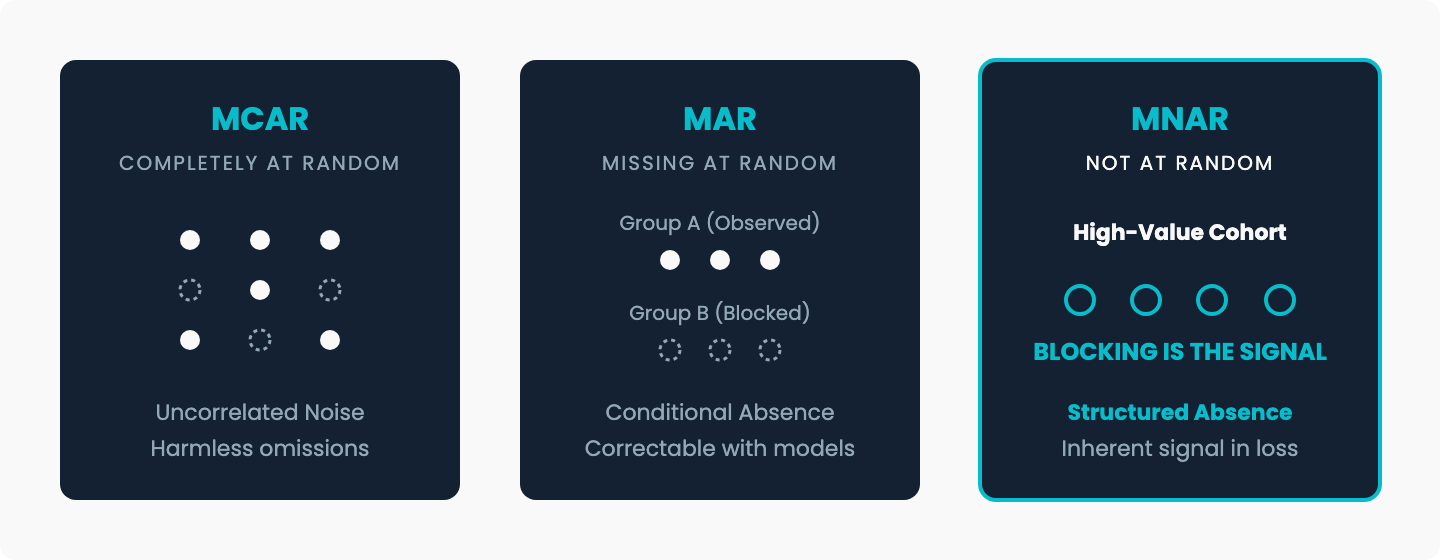
Here is the thing that the public conversation about tracking has not absorbed. When you block a tracker, you do not become invisible. You become a row with missing values. And missing values are not nothing; they are observations of a particular kind. Statisticians have a taxonomy for this, three categories with unlovely names. Data can be missing completely at random, as when a sensor fails for reasons unrelated to anything — noise, harmless. Data can be missing at random given what else is known — manageable, correctable. And data can be missing not at random, which means the very fact of its absence is correlated with the value that is absent. The visitors who block tracking are not a random sample of visitors. They are systematically more technical, more senior, more deliberate, and — in the business-to-business contexts where this arithmetic earns its keep — frequently more valuable than the visitors who click "accept all" to make the banner go away. The blocking is the signal. A dataset of website visitors with tracking-shaped holes in it is a textbook case of the third category, and the third category is the one where absence speaks loudest.
Literature got here before the statisticians. In 1969 Georges Perec published a novel of nearly three hundred pages, La Disparition, from which the letter e — the most frequent letter in French — is entirely absent. The book never announces its constraint. A contemporary reviewer, the story goes, read it and noticed nothing, which may be the most precise review the book ever received: he had mistaken absence for nothing. Perec's parents had disappeared in the war — his father to a German shell, his mother to the camps — and the novel is their memorial, grief encoded as a missing vowel; the fifth chapter is not there, for the fifth letter. The point matters beyond literature, and it is the point of this essay: an absence is not a lack of understanding. A structured absence is a statement — complete, deliberate, and legible to any reader attending to the structure that surrounds it. The careful reader reconstructs the missing letter from the shape of every sentence that had to bend around it. Nothing was hidden by the omission. Everything was said by it.
For most of the history of applied statistics, the honest response to such data was discomfort. One dropped the incomplete rows, or filled the gaps with averages, and a footnote confessed that the results were biased toward the easily observed. The discomfort has been resolved. The modern treatment — it is foundational in the Bayesian literature, stated plainly in the documentation of the standard tools — is that missing data are simply parameters: unknowns in a generative model, to be estimated jointly with everything else. One writes down a model of how the data arises and a model of why it goes missing, and lets the posterior do the work. The newer machinery scales this to thousands of features and does something the older methods could not: it returns its answers with honest uncertainty attached. Not "this anonymous visitor is a procurement director," but "0.7, give or take 0.3, and the width of that interval is itself informative, because it tells you they blocked collection on three of five visits — which tells you something else again." A researcher writing on this subject recently observed that the speculative part of such systems was never the mathematics, which has existed in journals for years, but the industrial assembly — and that the assembly has now become cheap. He is right. Every component is open source. The papers are public. The reconstruction of what was withheld, from the shape of the withholding, is no longer a capability; it is a download.
Set this arithmetic beside the regulatory apparatus that was built, at enormous expense, to govern it. The cumulative fines under the European data regime passed seven billion euros some time ago. A measurement study published this spring examined whether tracking had actually declined across the continent and found that it had — meaningfully — in two countries, the two whose regulators actively bring cases. The consent framework used by the substantial majority of European websites was ruled by a Brussels court to have no valid legal basis; the popups it produces are still there, on the same websites, asking the same questions. The regulation that was meant to consolidate all of this was withdrawn by its own institution this winter, returning enforcement to the patchwork it was meant to replace. I recite these facts without heat. Each is checkable. Together they describe a system that regulates the asking — the banner, the badge, the four-thousand-word policy — while the inferring proceeds underneath, indifferent, because inference does not require collection from you in particular. It requires a population, a pattern of holes, and a model of why the holes occur. The law governs a door. The arithmetic was never planning to use the door.
I should say plainly that I am not a bystander to this. Bouletteproof, the company I run, builds measurement infrastructure for businesses — the server-side variety, the kind that functions whether or not the browser cooperates, which is to say the kind this essay is about. I know how the profiles are assembled from fragments because assembling them is, in part, what we sell. This is why the subject interests me and also why I decline to perform indignation about it. The businesses that buy such tools know what they are buying: they want to understand who visits them and what their advertising money does. The visitors, for their part, mostly know they are measured and have made their peace at varying prices. The only party performing surprise is the apparatus in the middle — the certifiers, the badge-vendors, the authors of policies no one reads — whose entire economic existence depends on the premise that a banner stands between the visitor and the model. There is a word for selling protection that protects against nothing, but the word is uncharitable, and the people involved are mostly sincere, so I will leave it in its holster.
What would the honest version look like? I can describe it, because it is buildable and we have been sketching it. It does not begin with a banner. It begins with a page — linked from the footer, where the empty promises currently live — that contains a diagram. The diagram shows exactly what is collected, exactly what is reconstructed when collection is refused, the mathematics by which the reconstruction happens, and the uncertainty attached to every inferred quantity. It says: here is what we see when you allow everything; here is what we estimate when you allow nothing; here is how wide the error bars are in each case; here is why your blocker changes the second picture less than you think. No euphemism, no "we value your privacy," no consent theater — just the generative model, visible, the way the statisticians intended. This is not merely more honest than the current arrangement. It is, by a pleasing irony, the strongest position the law itself recognizes: consent given by someone who has been genuinely, technically informed is the most defensible consent there is. The banner asks permission while obscuring what is being permitted. The diagram obscures nothing, and in obscuring nothing, asks for a permission that means something. One of these survives an inspector with an ad blocker. We have seen what happens to the other.
There is a quieter point underneath, and it is the one I actually care about. A civilization that regulates the asking while ignoring the inferring has not made a technical error; it has revealed what the regulation was for. The banner was never load-bearing. It was a ritual of reassurance — for the visitor, who clicks it away; for the company, which frames the badge; for the legislator, who can point to it. Rituals have their place; I do not begrudge anyone theirs. But it seems worth saying, once, in plain terms, that the data was never in the place the ritual guards. It is in the shape of everything else — in the pattern of what is present, and the pattern of what is not, and in the now-ordinary mathematics that reads the second as fluently as the first. You cannot opt out of being an absence. The only choices on offer are whether the model that reads you is hidden or shown, point-estimated or honest about its uncertainty, denied or documented. Those are real choices, and they belong to the people who build the systems, of whom I am one. The banner was never one of them.
Notes. The three categories of missingness are known in the statistics literature as MCAR (missing completely at random), MAR (missing at random), and MNAR (missing not at random); visitor datasets shaped by ad blockers and tracking prevention are the third. The treatment of missing values as parameters in a generative model is standard in Bayesian inference — see the Stan documentation's chapter on missing data, and the family of variational models that jointly learn data and missingness mechanism at scale. The enforcement figures refer to cumulative fines under the GDPR; the two-country finding is from a 2026 web-measurement study of consent and tracking prevalence; the consent-framework ruling refers to the Brussels Court of Appeal's 2025 decision on the IAB's Transparency and Consent Framework (TCF); the withdrawn regulation is the ePrivacy Regulation, pulled by the European Commission in February 2026. The novel is Georges Perec's La Disparition (1969), translated by Gilbert Adair as A Void (1995). The case study in the opening is real and deliberately unattributed.
FAQ
Common questions
Can you be fined under GDPR while using a consent management tool?
Yes. In the case this essay covers, the consent tool blocked trackers exactly as configured and the client was fined anyway. Consent tooling governs collection; enforcement looks at the whole data picture — a certified banner is necessary, not sufficient.
What is MNAR data in web analytics?
Missing Not At Random — data that is absent for reasons correlated with what it would have said. Consent-blocked and ad-blocked visitors are MNAR: who is missing is itself informative, which is why naive analytics on the remaining traffic are biased.
Does blocking trackers make a visitor invisible?
No. It makes them a specific, structured kind of missing data. Absence has a shape, and both statisticians and regulators can read it.
More from Bouletteproof
We build the measurement infrastructure this essay describes — including HikrLink, short links with server-side click attribution, and the server-side tagging work in our engineering services.
Related: The Click Your Dashboard Filed Under “Direct” and How We Do SEO: Signals, Not Schedules.